By Janette O'Shaughnessy | Resonating Brands
You work in 15 towns. Your website only ranks in one. So somebody sells you a pack of "city pages." Fifty of them. Same text, different town name swapped in.
Six months later, none of them rank. Some of them dragged the rest of your site down with them.
This guide is for home service contractors who serve more than one town and want to show up in all of them, the right way. Here is how to build service area pages that Google rewards instead of ignores.
Why service area pages matter for contractors
If you're a service-area business, you probably hide your address on your Google Business Profile. That's the right call. Google says to remove your address if customers don't come to you.
But it creates a problem. Google's map pack leans hard on location. In Whitespark's 2026 Local Search Ranking Factors report, "physical address in city of search" is the #4 factor for map rankings. If your shop is in one town, it's hard to win the map pack in the next town over.
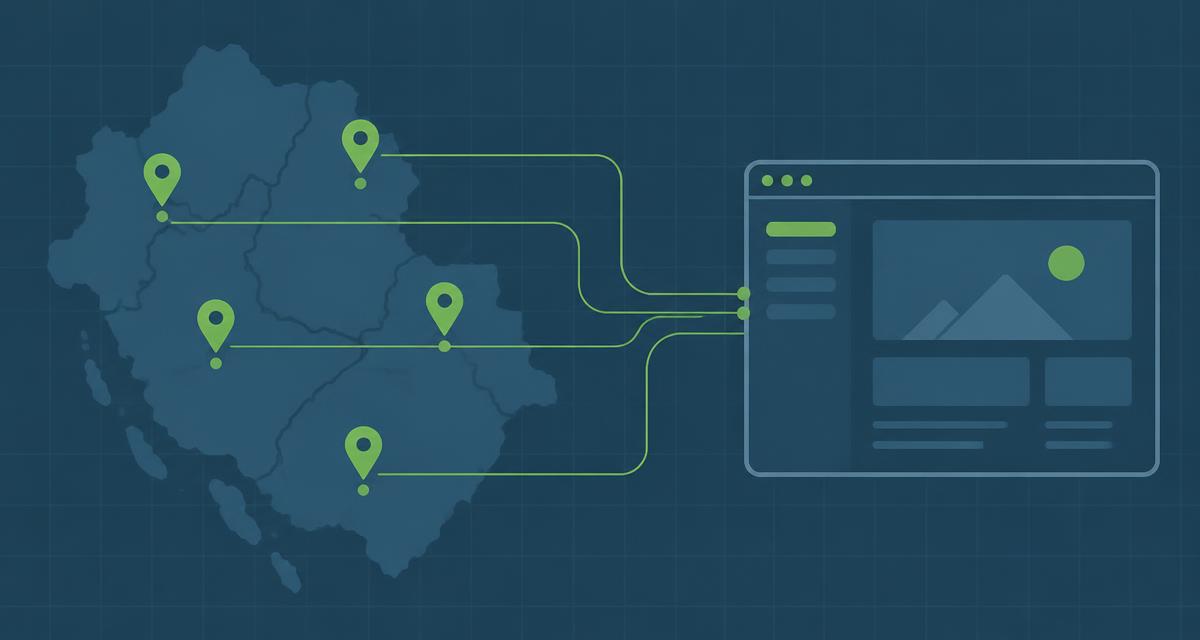
That's where your website comes in. Map rankings and regular search rankings are different. Your website can rank in the regular results for "roof repair in Zeeland" even if your profile is based in Holland. A strong service area page is how you get there.
It also matters for AI search. When a homeowner asks ChatGPT or Gemini "who's a good plumber in Grandville," the AI looks for pages that clearly connect your business to that place. A real, specific page about your work in Grandville gives it something to quote.
The trap: doorway pages
Here is where most contractors get burned.
Google has a spam policy for exactly this. It calls it doorway abuse: "when sites or pages are created to rank for specific, similar search queries." One of Google's own examples is "substantially similar pages" that exist to rank rather than to help people.
Google also has a policy on scaled content abuse: "when many pages are generated for the primary purpose of manipulating search rankings and not helping users." It doesn't matter if a person, a plugin, or AI wrote them.
Fifty city pages with the same text and a swapped town name? That's both.
Eric Scott Studios, a local SEO shop that works with contractors, puts the test in one line that we love:
> "If you could paste the same body under a different town name and nothing would be false, it's a doorway page."
And the damage isn't limited to those pages. Google judges quality across your whole site. A pile of thin pages can pull down your good ones.
The rule: every page needs something only true for that town
Stop thinking "city page." Start thinking "proof we work there."
A real service area page has information that could only be true for that town. If you don't have that information yet, don't build the page yet.
Here's what goes on a page that ranks.
1. A clear, specific headline
Your H1 should include the service and the town. "Roof Replacement in Zeeland, MI." Simple. The title tag and meta description should match.
2. Real jobs you did there
This is the most important section. Show two to four real projects in that town:
•Before and after photos from your own crews (not stock)
•The neighborhood or street area (never a customer's exact address without permission)
•What the problem was and what you did
Real job-site photos are one of the strongest local signals you can send. We explain why in Prove You're Local.
3. Local details a homeowner would care about
This is what separates a real page from a doorway page. Write about things that are specific to that place:
•Housing stock.: "Most homes in this subdivision were built in the 1990s, so we see a lot of original roofs reaching the end of their life."
•Weather and conditions.: Lake-effect snow. Hard water. Clay soil. Big old oaks over the houses.
•Permits and rules.: Does the town require a permit for a water heater swap? Is there an HOA that controls roof colors?
•Neighborhoods you serve.: Name them. Homeowners search by them, and AI tools read them.
4. Reviews from customers in that town
Pull in reviews that mention the town or come from customers who live there. BrightLocal's 2026 Local Consumer Review Survey found 74% of consumers look for reviews from the last three months. So keep these fresh.
5. Local FAQs
Answer the questions people in that town actually ask. "How long does a roof permit take in Zeeland?" "Do you service the lakeshore homes?" Short, direct answers. These are exactly what AI Overviews and chat tools like to quote.
6. A clear way to call or book
Click-to-call button. Short form. Your real phone number. Say plainly that you serve this town and how fast you can get there.
7. Links that make sense
Link to your main service pages. Link to nearby town pages. Link back to a main "Service Areas" hub page that lists every town you serve. This helps Google understand how your site fits together.
How many service area pages should you build?
Fewer than you think.
Eric Scott Studios recommends most single-location contractors build roughly 6 to 15 real pages, and only where you can fill the key sections with true, local information.
We'd add a simple way to decide which towns come first:
1.Where do your best jobs already come from? — Check your CRM or invoices.
2.Where do you want more work? — Higher home values, newer subdivisions, less competition.
3.Where can you prove it? — You need real jobs, photos, and reviews there.
Start with the towns that check all three. Add more as you do more work in new areas.
Also remember Google's own guideline for your Business Profile: your service area shouldn't be more than about two hours of driving from your base. Your website pages should follow the same common sense. A page for a town you'd never drive to is a red flag.
What about towns where you don't have jobs yet?
You have two good options.
Option 1: List them on your Service Areas hub page. A simple, useful list of every town you serve, grouped by county, is fine. It doesn't need a separate page for each.
Option 2: Wait until you have proof. Once you finish your first two or three jobs in a new town, build the page with those photos and that story.
What you shouldn't do is invent jobs or copy the same page again.
Service area pages vs. service pages
These are two different things, and you need both.
•A service page explains one service in depth. "Roof Replacement." "Furnace Repair." "Stump Grinding."
•A service area page shows your work in one place. "Roofing in Zeeland."
Your service pages build topical authority. Your service area pages build local relevance. Linked together, they tell Google and AI tools exactly what you do and where you do it.
For a bigger picture of what your site needs, see The Roofing Website Pages That Actually Win Jobs.
The technical details that matter
A great page still needs to be readable by search engines and AI tools.
•Each page needs a unique title tag and meta description.: No copy-paste.
•Each page should be in your sitemap.
•Add schema markup.: LocalBusiness schema with an areaServed property that names the town, plus FAQ schema for your local questions.
•Make sure the page loads fast on a phone.: Most homeowners will find you on mobile. See why mobile speed matters.
•Make sure the content is visible to crawlers.: Some website builders load content with JavaScript that search engines and AI bots struggle to read. Next generation websites render the full page for bots and people alike.
The bottom line
Google rewards proof, not promises. A page that says "We proudly serve Zeeland!" is a promise. A page with three Zeeland roofs you replaced this year, the subdivisions you work in, and reviews from Zeeland homeowners is proof.
Build fewer pages. Make every one of them true. That's how you rank in the towns you actually want.
Sources
•Google Search Central, "Spam policies for Google web search" (doorway abuse, scaled content abuse) — developers.google.com
•Google Business Profile Help, "Manage your service area for service-area businesses" — support.google.com
•Whitespark, "2026 Local Search Ranking Factors" — whitespark.ca
•Eric Scott Studios, "Service-Area Pages for Contractors: Template + the Doorway-Page Safety Rule" — ericscottstudios.com
•BrightLocal, "Local Consumer Review Survey 2026" — brightlocal.com
Janette O'Shaughnessy is the founder of Resonating Brands, a boutique digital marketing agency based in West Michigan that specializes in next generation websites, voice agents, and lead generation systems for home service contractors.
Continue Learning: Local SEO for Roofers · Google Business Profile Categories · Is Your Contractor Website ADA Compliant?