When business owners come to me frustrated that their website isn't showing up on Google, the problem almost always traces back to one of two things: what's on their site, or what's happening under the hood. Those two things have names in the SEO world — on-page SEO and technical SEO — and understanding the difference between them is one of the fastest ways to stop throwing money at marketing that isn't working.
I've built and optimized websites for roofing companies, tree services, veterinary practices, and other trades businesses across the country. In that work, I've seen gorgeous-looking websites that nobody can find — and I've seen technically sound websites that nobody wants to stay on. You need both. But they're not the same thing, and confusing them leads to wasted time and wasted budgets.
Let me break it down in plain language.
What Is On-Page SEO?
On-page SEO is everything that a visitor — and a search engine — can actually read on your website. It's the content, the words, the headlines, the page titles, and the way all of that is organized. When someone lands on your roofing page, on-page SEO is what tells Google: *this page is about roof replacement in Grand Rapids, Michigan, and it's worth showing to people searching for that.*
The most important on-page elements include:
•The page title tag — the headline Google shows in search results
•The meta description — the short summary under that title
•Your H1 and H2 headings: within the page
•The body content itself
Done right, on-page SEO means every page on your site is clearly focused on one topic, uses the words your customers actually search for, and gives visitors a reason to take action.
Keyword research is the backbone of strong on-page SEO. If your roofing company serves the Columbus, Ohio market, your page shouldn't just say "we do roofs." It should speak directly to what people are typing into Google — phrases like "roof replacement Columbus OH" or "emergency roof repair near me." Search engines read your pages looking for signals that your content matches what a searcher is looking for. On-page SEO is how you send those signals.
But on-page SEO isn't just about stuffing in keywords. It's about content quality — the kind of authoritative, useful, well-organized content that proves to both Google and your customer that you know what you're talking about. Internal linking matters too: when your service pages link to each other logically, it helps search engines understand the full picture of what you offer and gives visitors a clear path to conversion.
Think of on-page SEO as the message on your billboard. If the message is clear, relevant, and compelling, people pay attention.
What Is Technical SEO?
Technical SEO is everything that happens behind the scenes — the infrastructure of your site that search engines interact with before a human ever reads a single word. If on-page SEO is your billboard message, technical SEO is whether the billboard is actually on a road people travel, properly lit, and facing the right direction.
Technical SEO covers things like:
•How fast your pages load
•Whether your site works correctly on mobile devices
•Whether Google's crawlers can actually find and index your pages
•Whether your site is secure: (running on HTTPS rather than HTTP)
•Your site architecture — how pages are organized and linked
•Your XML sitemap and robots.txt file
•Structured data: (also called schema markup)
Here's why technical SEO is so critical: Google can't rank a page it can't find. If your site has broken pages, slow load times, or indexing errors, it doesn't matter how good your content is. The page simply won't show up. A website that takes more than three seconds to load loses the majority of visitors before they even see your message — and Google knows it.
One thing I see constantly with home service businesses is a beautiful website built on a slow or poorly configured platform. The business owner invested real money in design, good photography, maybe even solid copy — but the technical foundation is crumbling underneath. Pages aren't being indexed. Mobile experience is broken. Schema markup is missing, so Google doesn't understand the business's services, location, or reviews.
Technical SEO is also where a lot of the newer SEO demands live — things like Core Web Vitals (Google's performance benchmarks), canonical tags that prevent duplicate content issues, and structured data that helps your business appear in rich results like review stars or FAQ snippets in search results.
The Key Differences at a Glance
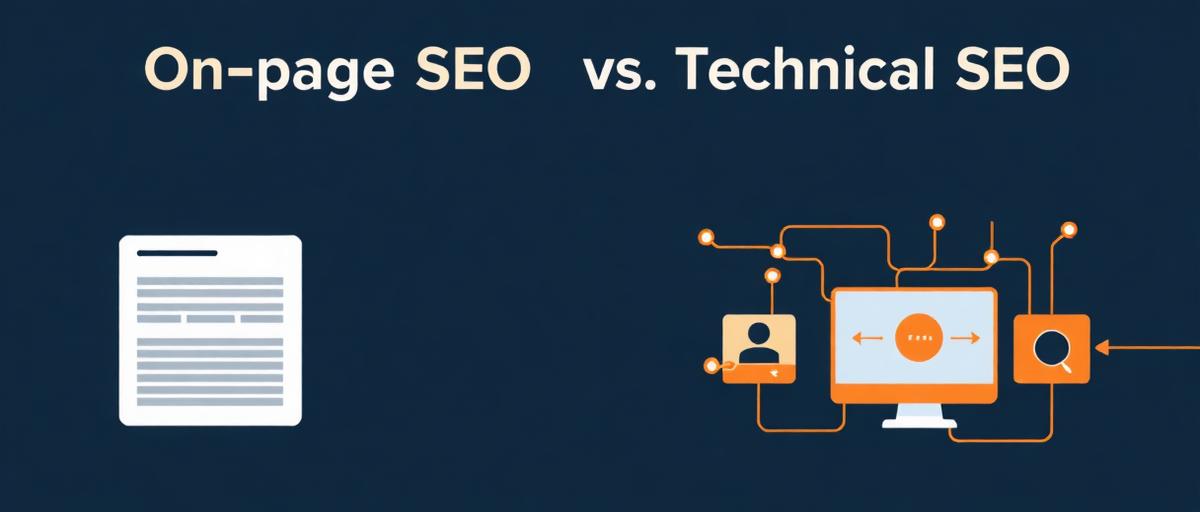
The simplest way I explain this to clients is this: on-page SEO is about relevance, and technical SEO is about access. You need your site to be relevant to what people are searching for, and you need search engines to be able to access and understand your site in the first place.
On-page SEO tends to be ongoing and iterative. You should be regularly refreshing your content, adding new service pages, publishing blog posts and articles that answer the questions your customers are asking, and refining your keyword targeting as your market evolves.
Technical SEO, on the other hand, often follows a "fix it once, maintain it always" pattern. Getting your site indexed correctly, setting up HTTPS, configuring your sitemap — those are foundational tasks. But they do require maintenance, especially when you add new pages, redesign your site, or change platforms.
Another important distinction: on-page SEO is largely subjective. There's no single "correct" way to write a page — it's a creative and strategic effort that depends on your audience, your market, and your voice. Technical SEO is much more objective. Either your site loads in under three seconds or it doesn't. Either Google can crawl your pages or it can't. The rules are clearer, and the solutions are more definitive.
A Quick Reference: On-Page SEO vs. Technical SEO
| On-Page SEO | Technical SEO | |
|---|---|---|
| Focus | Content and relevance | Site infrastructure and access |
| Who sees it | Visitors and search engines | Primarily search engines |
| Examples | Keywords, headings, meta tags, content, internal links | Site speed, mobile-friendliness, indexing, schema markup, HTTPS |
| Frequency | Ongoing and iterative | Foundational, with regular maintenance |
| Nature | Subjective (requires strategy and creativity) | Objective (measurable, rule-based) |
| Risk if ignored | Pages rank poorly for relevant searches | Pages may not appear in search at all |
Why You Need Both — And Why Order Matters
A lot of marketing agencies focus almost entirely on content and completely ignore the technical side. Others are technically brilliant but produce content that sounds like it was written for a robot, not a real customer. Neither approach works long-term.
The correct sequence is: fix the technical foundation first, then optimize your on-page content. There's no point in creating 40 perfectly written service pages if Google can't index them. And once your technical house is in order, great on-page SEO is what separates you from every other technically-sound competitor in your market.
At Resonating Brands, this is exactly why we build next generation websites rather than piecing together cheap templates. When we build a site for a roofing company, the technical foundation is built in from day one — fast load times, clean structure, mobile-first design, proper indexing signals, and schema markup that tells Google exactly what the business does and where it operates. Then we layer on strategic on-page SEO: the right keywords, the right content structure, the right internal linking — all designed to bring in the kind of traffic that converts into booked appointments, not just visits.
For a deeper look at how on-page SEO works for roofers specifically, see our local SEO guide for roofers. And if you want to understand the common technical mistakes we see on roofing websites, read roofing SEO mistakes to avoid.
The Bottom Line
SEO isn't one thing. It's a combination of strategies that work together — and understanding the difference between on-page and technical SEO helps you ask better questions, hold your marketing partners accountable, and make smarter investments in your digital presence.
If your website isn't bringing in leads, there's a reason. Either the message isn't right (on-page problem), the foundation is broken (technical problem), or both. The good news is that both are fixable — and when they're working together, a well-optimized site becomes one of the most powerful lead generation tools a contractor can have.
For a complete overview of how SEO, AEO, and GEO work together in 2026, read our SEO, AEO & GEO Ranking Guide.
Janette O'Shaughnessy is the founder of Resonating Brands, a boutique digital marketing agency based in West Michigan that specializes in next generation websites, voice agents, and lead generation systems for home service contractors.
Continue Learning: Roofing Marketing Hub · Local SEO for Roofers · Roofing SEO Mistakes · SEO, AEO & GEO Ranking Guide 2026 · Google Business Profile Setup