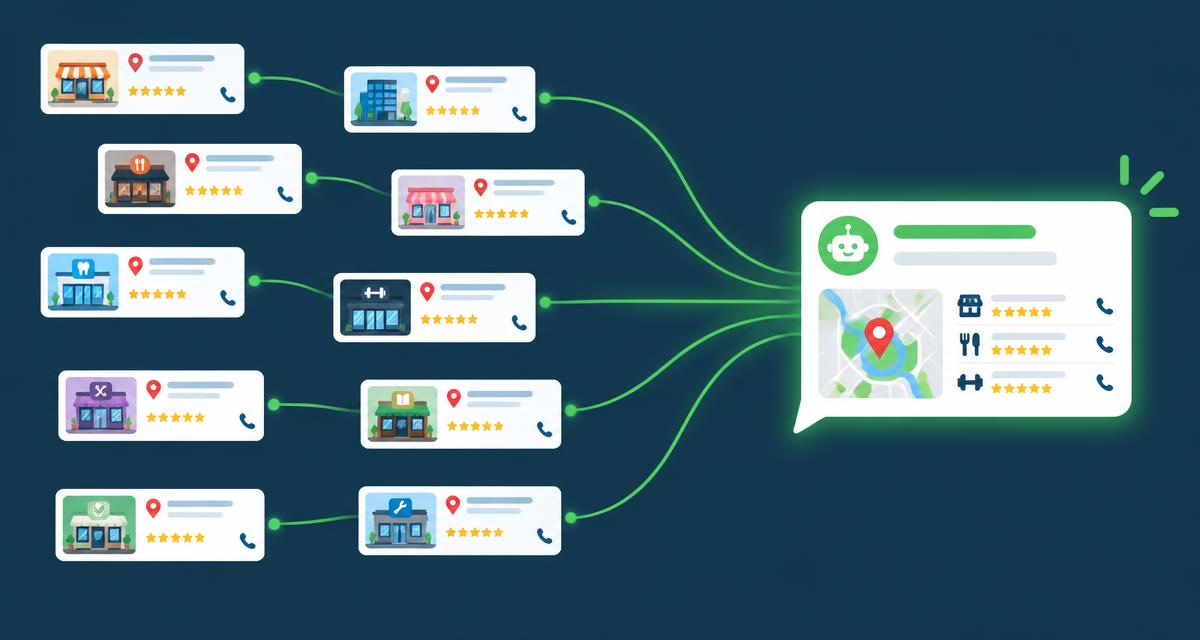
When a homeowner asks AI for a roofer, the AI doesn't make up an answer. It goes looking. And it looks in very specific places.
This one is for roofers, HVAC companies, plumbers, tree services, cleaners, and every home service owner who wants to show up when someone asks Google, ChatGPT, Siri, or Alexa who to call.
Here is the problem. Every platform pulls from a different set of sources. Google trusts Google. ChatGPT leans hard on Yelp. Siri reads Apple's listings. Alexa books through Angi and Yelp. If your business info is wrong, or missing, in the places a platform trusts, you're invisible on that platform. No matter how good your website is.
Below is where each major search engine and AI assistant gets its facts, and the short list of listings you need to get right.
The big picture: AI trusts what it can verify
AI platforms are nervous about recommending the wrong business. So they look for agreement. When your name, address, phone number, hours, and services match across your website, your Google Business Profile, Yelp, and the major directories, the AI trusts you. When they don't match, it hesitates. And when an AI hesitates, it recommends someone else.
BrightLocal recently studied nearly 2 million AI citations across more than 1,300 business locations. Two findings stood out:
•Google Business Profile made up roughly 28% of all citations across Google's AI features. It showed up for virtually every business.
•Yelp appeared in about 80% of ChatGPT's local answers. Google Business Profile wasn't even a top source for ChatGPT.
Read that again. The two biggest players use almost completely different sources. Getting one right is not enough.
Where each platform gets its data
Google Search, Google Maps, AI Overviews, AI Mode, and Gemini
Main sources: Google Business Profile, your website, Yelp, Facebook, BBB, Angi, MapQuest
Google runs on its own data first. Your Google Business Profile is the backbone of everything Google shows about you: the map pack, AI Overviews, AI Mode, and Gemini's local answers. In BrightLocal's data, Google Business Profile drove about half of all citations for plumbers.
But Google doesn't stop there. AI Mode also pulled from Yelp, Facebook, Angi, and BBB. And Google reads your website to fill in the details: services, service areas, pricing, FAQs.
What to get right: A complete, verified Google Business Profile with the right categories, real job photos, weekly posts, and fresh reviews. (See our Google Business Profile setup guide and how to pick the right categories.)
ChatGPT
Main sources: Yelp, Bing, Foursquare, your website, BBB, Angi, HomeAdvisor, Yellow Pages, Trustpilot
ChatGPT does not have its own map. It doesn't read your Google Business Profile directly. Instead, it pieces together local answers from licensed data, Bing's search index, and the directories it trusts.
Yelp is the big one. In July 2026, Yelp signed a deal to license its reviews, ratings, photos, and business listings to OpenAI. ChatGPT now shows Yelp content, with Yelp links, right in its local answers. Yelp's "Request a Quote" feature is planned for ChatGPT next, which means a homeowner could contact a contractor without ever leaving the chat.
ChatGPT also uses Foursquare's location data and Bing's index, which pulls from Bing Places. And for home services specifically, BrightLocal found ChatGPT citing BBB, Angi, HomeAdvisor, and Yellow Pages.
Two home service marketplaces now live inside ChatGPT, too. Thumbtack partnered with OpenAI in late 2025, and Angi launched an app in ChatGPT in March 2026 that connects homeowners with local pros.
What to get right: Claim and complete your Yelp page. Claim Bing Places. Make sure your Angi, BBB, and HomeAdvisor profiles are accurate. (More in how to get your roofing company recommended by ChatGPT.)
Microsoft Copilot and Bing
Main sources: Bing Places, Bing's web index, your website, Yelp
Copilot runs on Bing. Bing Places for Business is Microsoft's version of Google Business Profile, and most contractors have never touched it. That's a mistake, because Bing's index also feeds ChatGPT's search results.
What to get right: Claim Bing Places. You can import your Google Business Profile directly, so it takes about ten minutes.
Siri and Apple Maps
Main sources: Apple Business Connect, Yelp, data aggregators
Every iPhone user who asks Siri for "a plumber near me" gets an answer from Apple Maps. Apple Business Connect is Apple's free tool for claiming and managing that listing. You can add your hours, photos, logo, and action buttons like "Call" and "Get a Quote."
Apple has long pulled reviews and business details from partners, and Yelp licenses its data to Apple. Apple also buys business data from the big data aggregators (more on those below).
What to get right: Claim your listing in Apple Business Connect. Then make sure your Yelp page matches it.
Alexa
Main sources: Yelp, Angi, Square
Amazon's new Alexa+ is built to do more than answer. It books. In December 2025, Amazon announced Alexa+ integrations with Angi and Yelp. Homeowners can ask Alexa to find a plumber, compare providers by price, reviews, and availability, request quotes, and book, all by voice.
What to get right: Your Angi and Yelp profiles. If those are thin or wrong, Alexa has nothing to recommend.
Perplexity
Main sources: Its own web index, Yelp, your website, review sites
Perplexity added Yelp's local business data in 2024 to show maps, photos, and reviews in local answers. It also reads the open web heavily, so your website, local news mentions, and review sites all count.
What to get right: Yelp, plus a website with clear, answer-ready content and schema markup so Perplexity can read your services and service areas.
Claude
Main sources: Brave Search, your website
When Claude searches the web, it uses Brave Search. Brave has its own independent index, separate from Google and Bing. That means your website and the pages that mention you matter most here.
What to get right: A fast, crawlable website with real answers on the page. Most homeowners aren't using Claude to find a contractor yet, but this is where your website does the heavy lifting.
Quick reference: who reads what
| Platform | Most important sources |
|---|---|
| Google Search, Maps, AI Overviews, AI Mode, Gemini | Google Business Profile, your website, Yelp, Facebook |
| ChatGPT | Yelp, Bing, Foursquare, your website, BBB, Angi |
| Microsoft Copilot | Bing Places, your website |
| Siri / Apple Maps | Apple Business Connect, Yelp, data aggregators |
| Alexa+ | Angi, Yelp |
| Perplexity | Yelp, your website, open web |
| Claude | Brave Search, your website |
The hidden layer: data aggregators
Here's something most contractors have never heard of. A handful of companies sell business data to the platforms above. They're called data aggregators. If one of them has your old phone number, that mistake can spread to dozens of sites you never signed up for.
The ones that matter in the U.S.:
•Foursquare supplies location data to ChatGPT, Uber, Nextdoor, and others.
•Data Axle (formerly Infogroup) feeds search engines, in-car navigation, and directories.
•TransUnion Digital Business Profile (formerly Neustar Localeze) feeds Apple, Bing, Nextdoor, and more than 80 other platforms.
You don't have to manage each of these by hand. A listing management service can push correct info to all of them at once. But you do need to make sure someone has.
The home service directories that matter most
For general businesses, Google and Yelp carry most of the weight. For the trades, a few more sites matter because AI platforms trust them for contractors specifically.
Tier 1: Fix these first
1.Google Business Profile. The foundation for Google, Gemini, and Google Maps.
2.Your website. Every platform reads it. It's the one source you fully control.
3.Yelp. Feeds ChatGPT, Siri, Alexa, Perplexity, and Bing. Even if you've ignored Yelp for years, you can't anymore.
4.Bing Places. Feeds Copilot and ChatGPT's search. Takes ten minutes.
5.Apple Business Connect. Feeds Siri and Apple Maps on every iPhone.
Tier 2: Trust signals for the trades
6.Angi and HomeAdvisor. Feed Alexa+, ChatGPT, and Google's AI Mode.
7.BBB. Cited by ChatGPT and Google for contractors. Accreditation isn't required to have an accurate profile.
8.Facebook. A top-three source for Google's AI features.
9.Thumbtack. Now built into ChatGPT for home services.
10.Nextdoor. Where neighbors recommend contractors to each other, and Nextdoor buys data from the aggregators.
Tier 3: Trade and local credibility
11.Houzz, especially for remodelers, roofers, and exterior work.
12.Manufacturer directories, like GAF, Owens Corning, CertainTeed, Carrier, Trane, or Lennox dealer locators. These are strong proof of expertise.
13.Your local Chamber of Commerce and trade associations.
14.MapQuest and Yellow Pages. Old-school, but AI still cites them.
What "getting it right" actually means
Claiming a listing is step one. Here's what makes AI trust it.
•Exact same name, address, and phone number everywhere. "Smith Roofing LLC" on Google and "Smith Roofing & Exteriors" on Yelp looks like two different companies to a machine.
•Same hours, same services, same service areas. If your website says you serve Holland and Zeeland, your listings should too.
•Real photos. Job site photos with the location data left in. AI uses them as proof you work where you say you work. (See prove you're local with job site photos.)
•Recent, detailed reviews on more than one platform. A 4.9 on Google and zero reviews on Yelp is a problem now that ChatGPT reads Yelp. (See why your 300 reviews from 2022 aren't selling for you anymore.)
•Schema markup on your website that matches your listings exactly: business name, address, phone, services, service areas, and links to your profiles.
•A way to book or request a quote. Alexa, ChatGPT, and Google are all moving toward booking for the customer. Give them a button to press.
Your action plan
1.Google yourself, then ask the AI. Ask ChatGPT, Gemini, Siri, and Alexa, "Who's the best [your trade] in [your town]?" Note who shows up and which sites they cite.
2.Write down your official business info. One exact version of your name, address, phone, hours, services, and service areas. That's your master copy.
3.Fix Tier 1 this week. Google Business Profile, website, Yelp, Bing Places, Apple Business Connect.
4.Fix Tier 2 this month. Angi, HomeAdvisor, BBB, Facebook, Thumbtack, Nextdoor.
5.Clean up the aggregators. Use a listing management service, or have your marketing partner do it.
6.Ask for reviews on more than Google. Rotate customers between Google and Yelp.
7.Check every quarter. Listings drift. Old info creeps back in. Set a reminder.
Frequently asked questions
Where does ChatGPT get information about local businesses?
ChatGPT combines licensed data and web sources. Yelp is its biggest local source. Yelp licensed its reviews, ratings, photos, and listings to OpenAI in July 2026. ChatGPT also uses Bing's search index, Foursquare location data, business websites, and directories like BBB, Angi, and HomeAdvisor. It does not read Google Business Profile directly.
Does Google Business Profile matter for AI search?
Yes, for Google's AI. Google Business Profile is the top source for AI Overviews, AI Mode, and Gemini, making up roughly 28% of all citations in BrightLocal's study. It matters much less for ChatGPT, which relies on Yelp and Bing instead.
Do I really need a Yelp page as a contractor?
Yes. Yelp now feeds ChatGPT, Siri and Apple Maps, Alexa, Perplexity, and Bing. In BrightLocal's study, Yelp appeared in about 80% of ChatGPT's local answers. An empty or wrong Yelp page hurts you on almost every AI platform outside Google.
Where does Siri get business information?
Siri uses Apple Maps. Apple Maps listings come from Apple Business Connect, Apple's free listing tool, along with partner data such as Yelp and business data aggregators.
What are data aggregators?
Data aggregators are companies that collect business information and sell it to search engines, map apps, and directories. The main U.S. aggregators are Foursquare, Data Axle, and TransUnion Digital Business Profile (formerly Neustar Localeze). Wrong data at an aggregator can spread to dozens of sites.
Which directories matter most for home service contractors?
Start with Google Business Profile, your website, Yelp, Bing Places, and Apple Business Connect. Then add Angi, HomeAdvisor, BBB, Facebook, Thumbtack, and Nextdoor. Manufacturer dealer directories and Houzz add trade credibility.
The bottom line
Every AI platform has its own short list of sources it trusts. Google reads Google. ChatGPT reads Yelp and Bing. Siri reads Apple. Alexa reads Angi and Yelp.
The contractors showing up across all of them are not always the biggest. They're the ones whose information is correct, consistent, and complete everywhere the AI looks.
Most of your competitors have one good Google profile and a mess everywhere else. That's your opening.
Not sure what the AI sees when it looks you up? Contact Resonating Brands and we'll check your listings across Google, ChatGPT, Siri, Alexa, and the directories that matter, and show you exactly what to fix.
Want the bigger picture? Read the biggest shift in search since Google itself.
Sources
•BrightLocal, "Where to get local citations for AI search", August 2026
•Axios, "Yelp partners with ChatGPT to surface reviews", July 23, 2026
•MarTech, "Yelp brings reviews and local leads to ChatGPT", July 2026
•Amazon, "Alexa+ voice booking integrations", December 2025
•Angi, "Angi launches the Angi app in ChatGPT", March 4, 2026
•Business Wire, "Thumbtack partners with OpenAI to power home services in ChatGPT", October 2025
•Local Falcon, "ChatGPT local search data sources"
•Maginative, "Perplexity enhances AI search engine with direct Yelp data integration", March 2024
•Xponent21, "Claude web search and Brave"
•TechCrunch, "Apple Maps business listings get more detailed with Apple Business Connect"
•BrightLocal, "What are data aggregators?"