By Janette O'Shaughnessy | Resonating Brands
I sat down with a roofing owner last month who was rightfully proud of his Google profile.
Three hundred and eleven reviews. A 4.8 average. Years of work, real customers, real jobs. By any reasonable definition, he had built one of the strongest reputation profiles in his market.
He believed those reviews were doing the heavy lifting on his marketing. Quietly producing leads. Closing skeptical homeowners. Outranking competitors. He believed it because every home services owner is told to believe it.
I had to tell him something he did not want to hear.
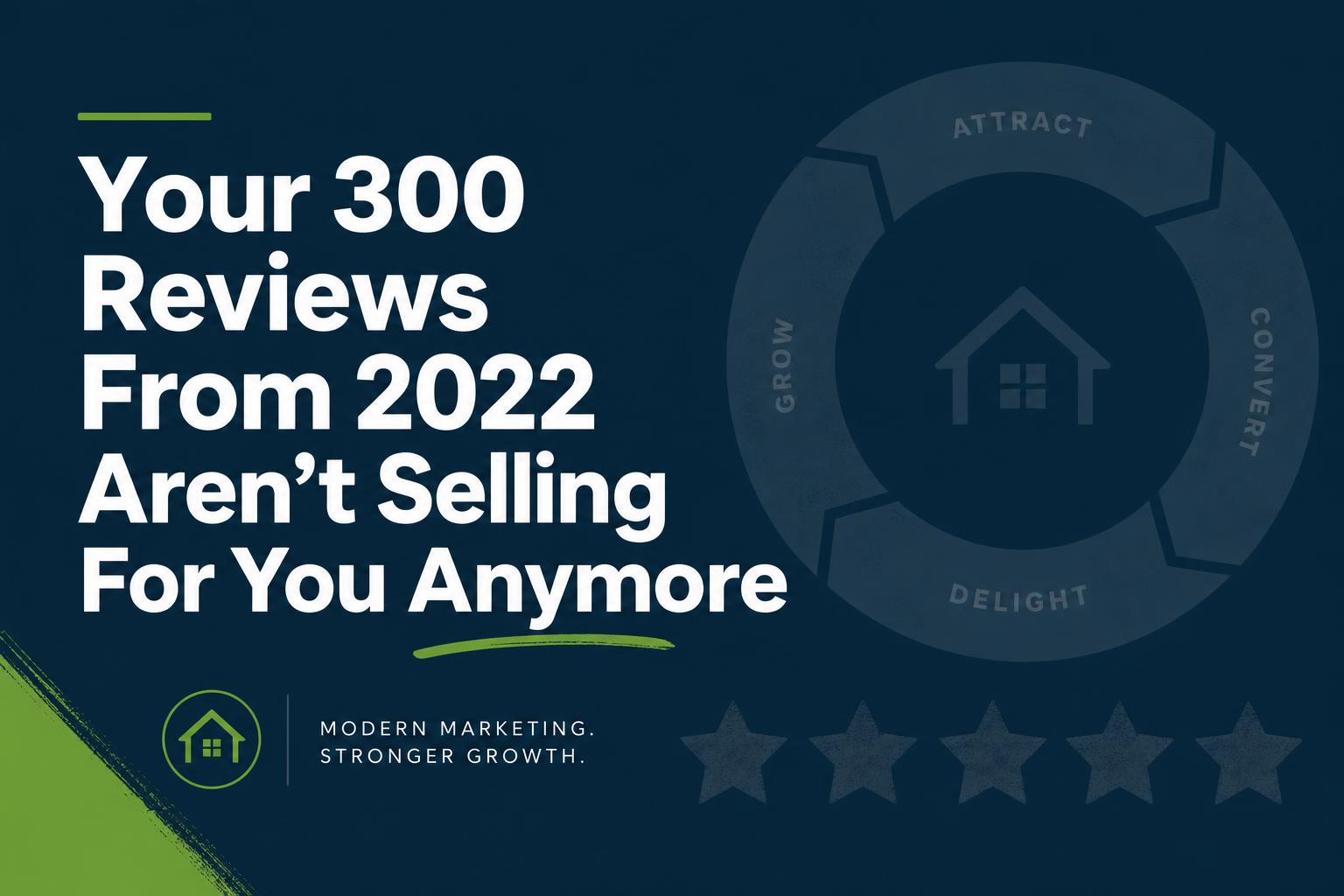
A lot of those reviews are not selling for him anymore.
Not because they aren't good. Not because his work isn't strong. Because of how the consumer brain — and the platforms — actually use reviews in 2026.
This is the part of the conversation most marketers don't have with their clients, and it is the single most expensive misconception in local marketing right now: the belief that reviews are a permanent asset.
They aren't. But what they build is.
The Misconception Worth Naming
Most home services owners I work with think of reviews like savings — once earned, always there, quietly compounding interest in the background.
That mental model produces a specific behavior. The owner spends the first two or three years of business doing a real push for reviews. They send the follow-up texts. They ask in person. They thank the family that wrote the kind one. The profile builds.
Then, somewhere around the 200- to 300-review mark, the push stops. The owner concludes the asset is built. They move on to the next thing — paid ads, social media, a website rebuild, hiring.
The reviews keep sitting there, slowly going stale.
The owner cannot understand why their lead flow has plateaued. They have great reviews. They have more reviews than most of their competitors. So why isn't it producing the way it used to?
Here's the part the consumer behavior research has gotten very clear about in the last two years.
Individual Reviews Have a Shelf Life
BrightLocal's 2026 Local Consumer Review Survey is the most current and rigorous data we have on how consumers actually use online reviews, and the findings are unambiguous.
74% of consumers specifically seek reviews written in the last three months. 32% look for reviews written in the last two weeks — up from 20% a year earlier. 18% are only swayed by reviews written within the past seven days. Reputation.com's separate research found that only 39% of consumers find value in feedback that is more than a year old.
Translated into a single sentence: the consumer brain weighs reviews by freshness, and old reviews lose influence almost as fast as old news.
This isn't unique to home services. It's a pattern across every category. A homeowner deciding whether to call you is doing the same thing they do when reading restaurant reviews or product reviews — looking at the rating, then scrolling for evidence that this business is still good right now.
A flood of glowing five-star reviews from 2022 reassures almost no one in 2026. The consumer assumes anything could have changed in three years — the crew, the owner, the standards. What they want to see is a recent customer saying, in plain language, that the business is still doing the work well.
If your last fresh batch of reviews was last spring, your profile is doing less for you than you think.
Half-Life Is the Rule, Not the Exception
This is also worth sitting with for a moment, because it is true of almost every marketing tactic — not just reviews.
Paid ads stop the day you stop paying for them. Social posts get buried within hours or days. Even a well-built website starts losing SEO rankings the moment the work stops being maintained. Email campaigns expire in the inbox within a single morning. Direct mail goes in the recycling bin the same afternoon.
The hard truth most marketers will not say out loud: there is no marketing asset that produces forever on its own. Everything has a half-life.
Reviews are no exception. But — and this is the part that matters — the system that produces reviews is different. That is the asset worth understanding.
What Actually Compounds
Reviews do not compound at the individual level. The system around them does.
Picture it as a flywheel with four parts moving together:
1.Steady velocity. — The rate at which new reviews come in. This is the single signal that tells both consumers and algorithms whether the business is still active, still doing good work, still worth recommending right now. Whitespark's 2026 Local Search Ranking Factors report — the most authoritative local-SEO survey in the field — found that review velocity and consistency now move local rankings in ways they did not five years ago.
2.Cumulative volume. — Total review count still matters at the glance level. A business with 412 reviews looks more established than a business with 14, even if the 14 are recent. Volume is the first trust signal; it is not the only one.
3.Average rating. — BrightLocal's 2026 survey found that 92% of consumers care about star ratings when choosing a business. 40% will not consider a business rated below four stars at all. AI engines are even more selective: independent research found that ChatGPT typically only recommends businesses averaging 4.3 stars or higher, and Gemini drops to 3.9. Below those thresholds, businesses are simply not surfaced.
4.Response rate. — This is the one most owners ignore. BrightLocal's data suggests businesses that respond to 75% or more of their reviews are perceived as nearly three times more trustworthy than businesses that do not. Responding to a bad review signals that the business cares. Responding to a good review signals that the business is run by a human paying attention.
When all four are running together, the flywheel turns. The business stays visible. The rankings hold. The AI engines surface it. The consumer trusts it. New leads come in. New customers leave new reviews. The flywheel keeps turning.
Stop earning new reviews, and the flywheel slows. Not immediately. Not dramatically. But quietly and steadily — until the owner is sitting across from someone like me, asking why the lead flow plateaued.
Why Google and AI Engines Care Even More
Two things have changed in the last two years that make this flywheel matter more, not less.
The first is Google's own confirmation. Google's Business Profile help documentation explicitly states that "more reviews and positive ratings can help your business's local ranking" — and it lists reviews under the "prominence" pillar of how local results are decided. This isn't marketing speculation. Google itself is telling you reviews drive rankings.
The second is the rise of AI as a search layer. Yext's 2025 analysis of 6.8 million citations across ChatGPT, Perplexity, and Gemini found that AI engines are now pulling directly from review platforms when answering questions like "who's the best plumber near me?" Perplexity specifically weights customer reviews heavily; ChatGPT trusts the internet's aggregate signal, which is driven by review data; Gemini leans on what businesses say about themselves but is influenced by ratings.
BrightLocal's separate 2026 research found that half of consumers are now asking AI engines for local business recommendations.
The implication: a stagnant review profile doesn't just hurt your Google ranking. It hurts whether AI engines mention your name at all.
What To Do — In Order
If you've recognized your business in this article, here is the order I would work through. None of this is complicated. All of it is consistently overlooked.
Stop assuming the asset is built. It isn't. Review-building is not a phase you complete and move past. It is a system that runs as long as the business does.
Systematize the ask. BrightLocal's data shows 76% of consumers will leave a review when asked — up from 70% in 2018. Most won't volunteer one unprompted, especially happy customers. The unhappy ones are roughly ten times more likely to leave an unprompted review than the happy ones. Without a system, your average rating is biased downward from reality.
Match the request to the moment. The single best time to ask for a review is within the first 24 hours after a finished job, while the customer is still in the satisfaction window. Same-day text, same-day email, same-day in-person ask. The longer the delay, the lower the response rate.
Respond to every review. Not eventually. Within 48 hours. Bad reviews especially. A measured, professional response to a bad review will convert more would-be customers than ten more five-star ratings.
Watch the cadence, not the spike. Local SEO research has surfaced that Google's algorithm appears to scrutinize sudden review spikes (which look manipulative) more than steady cadence. A rhythm of three or four real reviews a week is worth more than thirty in a single day.
Aim for relevance, not just volume. Encourage customers to mention what they hired you for, where they are located, and what kind of job it was. Search algorithms — both Google and AI — pull keywords directly from review text when deciding what your business is known for.
The Honest Bottom Line
The myth worth retiring is that reviews are a one-time asset you build and own forever.
They are not. They are a flywheel — a system that compounds for as long as you keep feeding it, and slowly loses momentum the moment you stop.
In 2026, with paid ad costs continuing to climb across home services (the LocaliQ benchmarks have HVAC at roughly $45 per lead, plumbing at $52, and roofing at $79, and 69% of advertisers seeing cost-per-lead rise year over year), the businesses with strong review flywheels have something their competitors cannot easily buy. They have ongoing visibility on Google, recommendations from AI engines, and trust from consumers — earned every quarter, not earned once.
That is the asset worth building. Not a static collection of reviews from your best year. A running system that keeps producing them now, and in the quarter after that, and in the one after that.
The Question Worth Asking
Before you next think about your reviews, ask the question I ask every client:
Is your review profile still earning reviews this quarter — or just sitting on the ones it earned three years ago?
The honest answer to that question is the difference between a flywheel that keeps turning and a profile that quietly stops working for you.
The good news is the system is not hard to build. It just has to be built deliberately. And once it is running, it produces one of the only forms of marketing that actually keeps paying you back.
If your review flywheel has stalled, that is worth a conversation. Resonating Brands builds reputation systems for home services businesses that are tired of doing the work and watching the asset go stale. We don't manage reviews after the fact. We build the flywheel that earns them now.
Talk to us about your reputation strategy →
Continue Learning: Roofing Marketing Hub · Review Generation Strategy for Roofers · How to Respond to Negative Reviews · AEO for Roofers: ChatGPT, Gemini, Perplexity & Claude