By Janette O'Shaughnessy, Founder, Resonating Brands
Let me be direct with you: the way homeowners find and hire contractors is changing faster than most business owners realize. And the companies that don't adapt in the next two to three years aren't just going to fall behind — some of them are going to disappear.
That's not a scare tactic. It's what I'm seeing on the ground, every day, working with roofing companies and home service businesses across the Midwest and beyond. The rules that worked in 2019 — or even 2022 — are being rewritten. And AI is doing the rewriting.
Here's what you need to understand, and more importantly, what you need to do.
The Search Landscape Has Shifted Under Your Feet
Not long ago, the goal was simple: rank on the first page of Google, get clicks, get calls. SEO was about keywords, backlinks, and showing up in the map pack. That still matters. But it's no longer the whole picture.
Homeowners are increasingly starting their search not with Google, but with AI tools — ChatGPT, Google's AI Overviews, Perplexity, and more. They're asking conversational questions like "Who are the most trusted roofing companies in Grand Rapids?" or "What should I look for when hiring a siding contractor?" — and getting a direct answer back, without ever clicking a single link.
That answer might include your company. Or it might not. The difference isn't random.
AI tools make recommendations based on who has built the most findable, trustworthy, and well-documented presence online. It's not just about your website anymore. It's about your entire digital footprint — and whether AI can read it, understand it, and trust it enough to put your name in front of a homeowner.
This is the new game. And right now, most local contractors aren't playing it.
What Actually Needs to Change — And Why
1. You Need to Be the Answer, Not Just a Result
Traditional SEO got you on a list. AI search makes you the recommendation. That's a fundamentally different goal, and it requires a different strategy.
To show up in AI-generated answers, your business needs what I call answer-ready content — content that directly addresses the questions homeowners are asking. Not keyword-stuffed paragraphs written to game an algorithm, but real, clear, useful information that demonstrates expertise.
Think about the questions your customers ask you every week. How long does a roof replacement take? What's the difference between architectural and 3-tab shingles? Will my insurance cover storm damage? Those questions are being typed into AI tools every single day. If your website answers them clearly and authoritatively, you become a source AI can draw from. If your website is three pages with a phone number and some stock photos, you're invisible.
FAQ pages, service explainers, blog posts written in plain language — these aren't extras anymore. They're infrastructure.
2. Reviews Are Your New Reputation Signal
This one is non-negotiable. AI tools don't just look at your website. They look at what other people say about you — and they're especially attentive to Google Reviews, Yelp, the BBB, and industry-specific platforms.
A company with 200 fresh, detailed reviews is going to surface in AI recommendations far more readily than a company with 18 reviews from four years ago. The recency matters. The volume matters. The specifics matter — reviews that mention your service area, the type of work done, and how the customer felt about the experience are far more useful to AI than a five-star rating with no text.
And here's something most contractors overlook: your responses to reviews matter too. When you respond thoughtfully to a negative review, or thank a customer for a detailed positive one, AI reads that. It signals that you're an engaged, accountable business. That earns trust — both from AI systems and from the humans reading those reviews.
If you don't have an active review generation process in place right now, that is your most urgent priority.
3. Speed-to-Lead Is a Competitive Weapon
I've worked with enough roofing companies to know the reality: most leads are followed up on the next morning, if they're lucky. A homeowner submits a contact form at 8pm, and someone calls them back at 9am. By that point, they've already talked to two other contractors.
AI is accelerating this problem. Homeowners who use AI tools to find a contractor are already primed for a fast, frictionless experience. They've gotten an instant answer from ChatGPT. They expect the actual business to move just as quickly.
The companies winning right now are deploying AI chat agents and voice agents to handle after-hours inquiries in real time — answering questions, qualifying the lead, and booking an estimate appointment before a human ever picks up the phone. Speed-to-lead in roofing can be the difference between a job won and a job lost. Five minutes versus five hours isn't a small gap. It's the whole game.
If you're still relying on a contact form and a callback, you are leaving significant revenue on the table.
4. A Generic Brand Won't Get Cited — A Specific One Will
Here's something I've noticed that surprises a lot of contractors when I say it: AI is less likely to recommend a company that sounds like every other company in its category.
Think about it from AI's perspective. It's trying to give a homeowner a useful, trustworthy recommendation. Between a roofing company whose website says "Quality work, great prices, serving the area for 20 years" and one whose website says "We specialize in storm damage restoration for residential homeowners in the greater Cleveland area, and we work directly with all major insurance carriers" — which one is more useful? Which one gives AI something real to work with?
Specificity builds authority. A defined niche, a clear service area, a documented specialty — these aren't just marketing choices. They're signals that AI systems use to decide whether your business is worth recommending.
This doesn't mean you have to turn away work outside your niche. It means you need to lead with something concrete and differentiated in your digital presence. Your unique story, your specialized expertise, your community roots — whatever makes you genuinely different needs to be clearly, consistently communicated across your entire online presence.
5. Local Signals Have Never Been More Important
AI search is deeply local. When someone asks "find me a good roofer near me," the AI isn't just searching the internet — it's triangulating location signals, proximity, local authority, and community credibility.
Your Google Business Profile isn't just a listing anymore. It's a live, dynamic signal that AI pays close attention to. Is it fully filled out? Are you posting updates? Are you categorized correctly? Are your photos current? Is your service area defined? These details, which many contractors set up once and never touch again, are actively influencing whether you show up in AI-powered local recommendations.
Local backlinks — mentions from your city's Chamber of Commerce, a local news story, a community sponsorship that got covered online — carry real weight. AI looks at your community presence as a proxy for trustworthiness. A contractor who is embedded in their local market is more credible than one who seems to exist only as a website.
If you haven't audited your Google Business Profile recently, do it this week.
6. Your Website Is Still the Foundation — But It Has to Work Harder
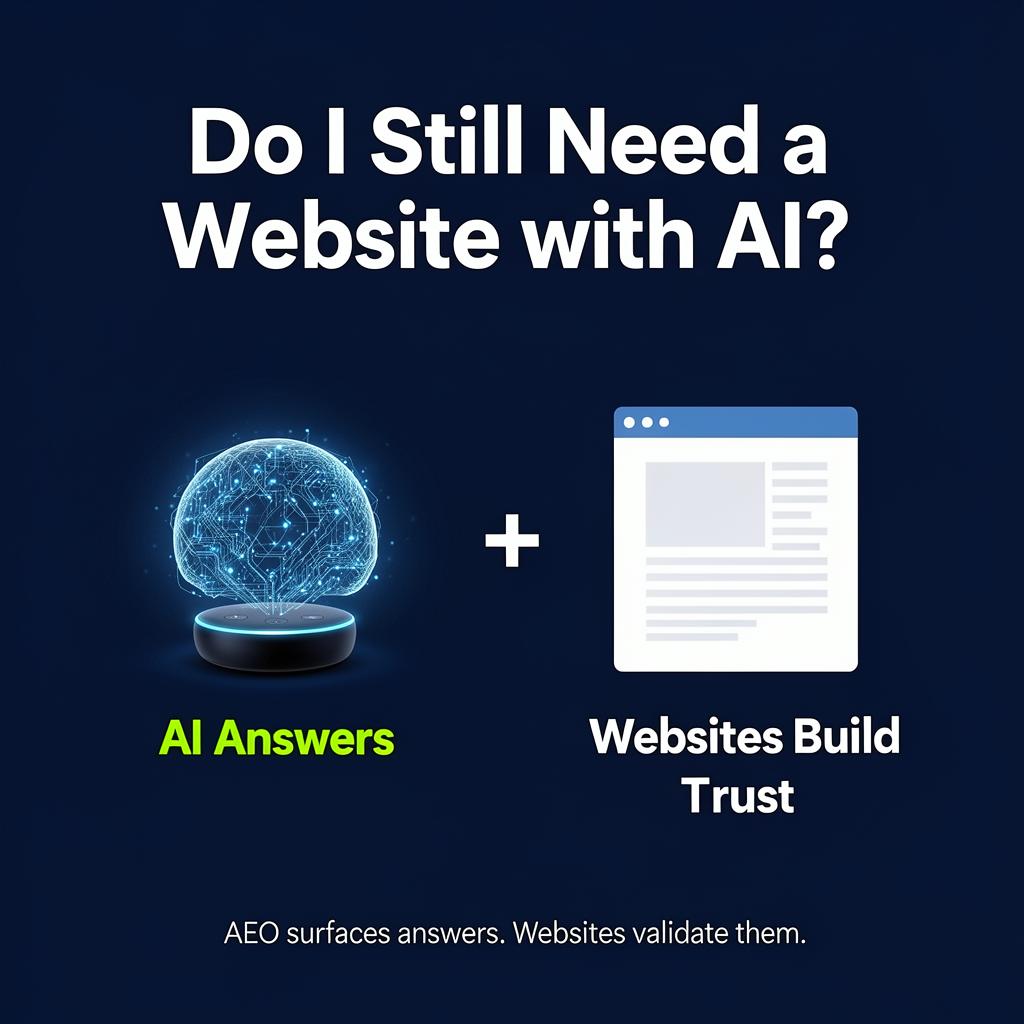
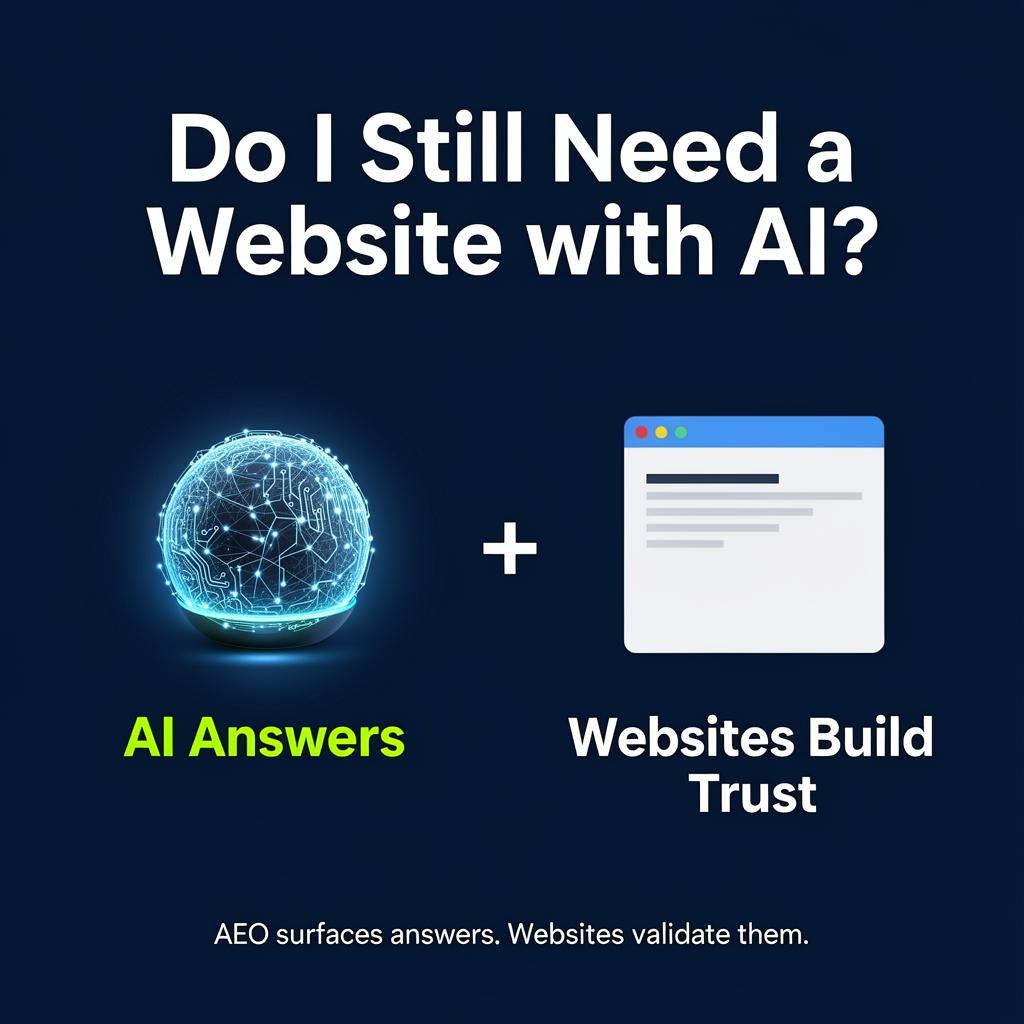
I've written before about why businesses still need websites in the age of AI. I'll say it again here because it bears repeating in this context: your website is the source document that AI reads to decide whether to recommend you.
Social media profiles, directory listings, and paid ads are valuable, but they don't give AI the depth of information it needs to confidently recommend your business. Your website — with detailed service pages, location content, FAQ sections, case studies, team bios, and schema markup — is what makes you legible to AI systems.
Schema markup in particular is something most local contractors don't have, and it's a meaningful advantage for those who do. It's a technical layer added to your website's code that essentially labels your information for AI — telling it clearly that you're a local roofing business, where you operate, what services you offer, and how to contact you. It removes ambiguity. AI rewards clarity.
A website built for the AI era isn't dramatically different from a well-built website for human visitors. It's clean, fast, authoritative, and organized. But the intention behind it has to be right — it needs to be built to answer questions, not just to look good.
The Honest Truth
I'm not going to tell you this is easy. Building an AI-ready digital presence takes time, consistency, and — frankly — the right partner. Most roofing and home service companies don't have an in-house marketing team with the bandwidth to do this work. And generic marketing agencies don't understand the specific dynamics of the trades.
What I will tell you is that the window for getting ahead of this is still open. Most of your competitors are not doing this yet. The contractors who build these foundations now — the reviews, the answer-ready content, the fast follow-up systems, the local authority, the technically sound websites — will have a compounding advantage that gets harder to close over time.
The best roofer in your market deserves to be found. AI just raised the bar for what "being found" actually means.
Janette O'Shaughnessy is the founder of Resonating Brands, a boutique digital agency based in West Michigan that builds next generation websites, voice agents, and local marketing systems for roofing and home service companies. She works with contractors who want to stop chasing leads and start attracting them.