By Janette O'Shaughnessy | Resonating Brands
I sit down with home services owners every week, and a version of the same conversation keeps coming up.
"We've been posting consistently for months. Nothing is happening."
They show me the feed. There are job photos. There are quick promo posts. There's the occasional "meet the team" graphic. By any reasonable definition, they are posting. But the social media is not producing — no calls from it, no new leads they can trace back to it, no real sense that anyone outside the family is watching.
It is one of the most frustrating places a business owner can land. Doing the work. Watching it disappear.
Here is what I have learned after years of running social media for service businesses: the issue is almost never frequency. It's not that they need to post more. It's that they think social media is one thing — when in 2026, it is actually three.
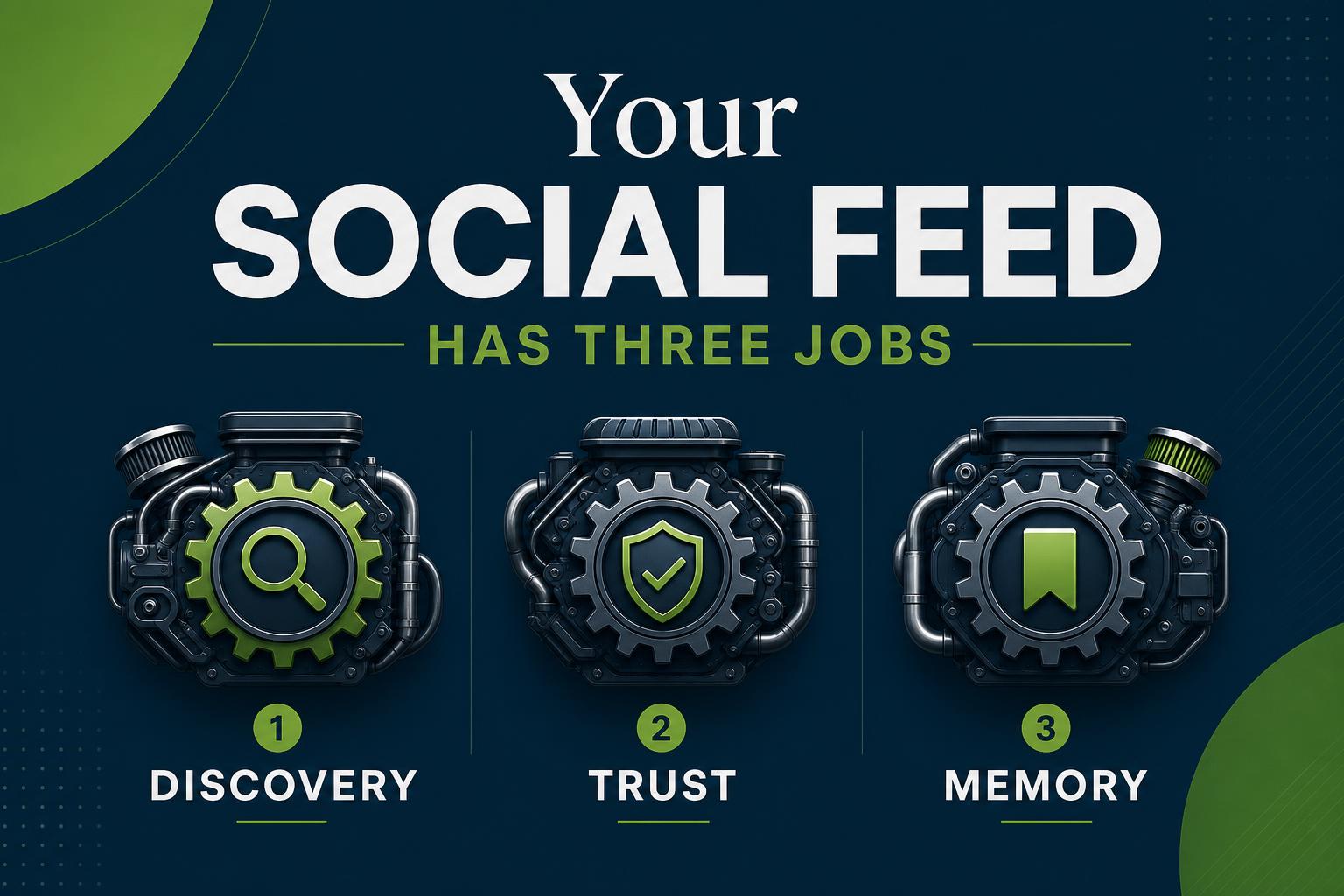
A social feed for a home services business has three jobs running at the same time. Most owners are only doing one of them. That is why their content feels like a billboard nobody pulls over for.
The Three Engines
Strong social media for a home services business runs on three engines. Each one does a different kind of work. Each one is measured differently. Each one has its own content rules. When all three are running, the feed becomes a real business asset. When one or two are missing, posting more does not fix it.
The three engines are discovery, trust, and memory.
Let me show you what each one is, what the current research says about it, and what it should look like in practice for a roofing company, a plumber, an electrician, or any home services business serious about its market.
Engine 1: Discovery
The job: Be findable when someone goes looking.
For a long time, social media was about being seen by people who already followed you. That is no longer the whole picture. Social platforms have quietly become search engines, and that has changed what "good content" actually means.
HubSpot's 2026 research found that 84% of social media marketers believe consumers will search for brands on social media more often than on Google. Anyone who has watched a homeowner under 40 plan a project has seen this in motion. They open TikTok or Instagram, type "kitchen remodel before and after" or "roof inspection what to look for," and let the platform serve them businesses, advice, and visual proof. They are searching. They are just doing it inside an app instead of inside Google.
That means your captions, on-screen text, and audio transcription are now part of how customers find you. A post tagged with five emojis and a vague slogan does not show up in those searches. A post that says, in plain language, "What to check on your roof after a hailstorm in West Michigan" does.
For a home services business, the practical shift is small but important:
•Stop writing captions for your followers.: Write them for the homeowner who is searching for what you do.
•Use the actual words people use.: Not "premier exterior solutions." "Storm damage roof repair." "Why my AC isn't cooling." "Old house, low water pressure."
•Add on-screen text to your videos: that names the problem and the location. Algorithms transcribe your audio and read your text. Use that.
The discovery engine is not optional anymore. If your content is not search-friendly, you are invisible to the customers who are actively trying to find someone like you right now.
Engine 2: Trust
The job: Convince a stranger that you are the right person to call.
Discovery gets you found. Trust gets you chosen. This is where most home services social media falls apart — because it is trying to look professional when it should be trying to feel real.
Sprout Social's 2026 content strategy report found that consumers say brands should make human-generated content their number-one priority, with AI used to power efficiency, not to replace human judgment or taste. The same report found that 73% of social users will buy from a competitor if a brand does not respond on social media. Real people, real voices, real responsiveness — these are not nice-to-haves anymore. They are the baseline.
For a service business, trust is built in the things polished marketing usually edits out:
•The crew on a roof, actually working.
•The owner explaining why they recommend one material over another, in their own words, in their own voice.
•A walkthrough of a finished basement with a customer in the frame.
•Before-and-after photos that look like real jobs, not catalog renderings.
•A response to a question in the comments that sounds like a person, not a brand.
Polished brand graphics, stock images, and generic "Call us today!" posts do the opposite of building trust. They make a real business look like every other business. That is the last thing a home services company needs in a market where customers are weighing referrals, reviews, and instinct.
The most trustworthy content is also usually the easiest to produce. A 30-second vertical video shot by a crew member on a job site, with the owner's voice over the top explaining what is happening, will outperform a designed graphic almost every time.
This is not because slick is bad. It is because real is rare.
Engine 3: Memory
The job: Be the name they think of when the moment of need arrives.
This is the engine almost no one is intentionally running, and it is the one that produces the most revenue when it does.
In home services, customers rarely buy because of a social post. They buy because the storm hit and they need a roof, the pipe burst and they need a plumber, the AC failed and the house is 88 degrees. At that moment, they are not browsing Instagram for vendors. They are reaching for a memory. The contractor whose name comes up first wins.
Memory is built by being useful enough, often enough, in the months before any of that happens.
Two pieces of research are worth knowing here. Instagram's Adam Mosseri confirmed in January 2025 that the platform's strongest ranking signals are watch time, likes-per-reach, and sends-per-reach (the rate at which people share your content via DM). Metricool's 2026 Reels guide reports that 694,000 Reels are sent via DM every single minute. The platforms are openly telling us: content that someone watches in full, finds useful enough to like, and especially useful enough to send to a friend or family member, is the content that earns reach.
For a home services business, that points to a very specific kind of content. Useful. Practical. Saveable. The post a homeowner sends to their spouse with "we should check this," or the one they save in their phone because their water heater is making a noise and they want to remember who explained that sound.
Some of the best memory-engine content for home services:
•"One sign your gutters are about to fail."
•"What to check on your furnace before winter."
•"Five questions to ask any contractor before signing."
•"Why your basement smells musty in summer — and what to do about it."
These posts do not pitch. They do not sell. They quietly become the reason a homeowner thinks of your name three weeks later, when something goes wrong.
The other piece of memory is showing up in the rhythm of a series. A weekly format — "Maintenance Monday," "Ask the Owner," "Jobsite Walkthrough," "Storm Season Check" — gives followers a reason to expect your content and creates pattern recognition. They start associating your face with a category. When the category becomes a problem, your face is the one they reach for.
How the Engines Work Together
Here is the part most owners never see clearly until someone draws it for them. The three engines do not compete. They feed each other.
Discovery brings new homeowners to your feed. Trust convinces them you are worth following. Memory is the long game that keeps you in their mind until they need you.
A post can do more than one job. The strongest content usually does all three. A short video of an owner explaining what to look for after a hailstorm uses search-friendly language (discovery), shows a real expert speaking plainly (trust), and gives the homeowner useful information they may save and reference later (memory).
That is what we mean when we say a feed should be working as a system, not as a posting calendar.
What This Looks Like in Practice
If you are reading this and recognizing that your social feed has been running on one engine while the other two sit idle, here is the shift I would make this month, in order:
1.Pick three content pillars and stop trying to cover everything. — For most home services businesses, the right buckets are education (discovery + memory), proof (trust), and team/local (trust + memory). Five pillars is too many. One pillar is too few. Three is what most owners can sustain.
2.Shoot from the job site, not the desk. — Ask your crew to capture short vertical clips at every job: a quick problem explanation, a before-and-after, a finished walkthrough. Two minutes of phone footage from a real job is worth more than an hour of designed graphics.
3.Stop optimizing for likes. — Track saves, shares, DMs, profile visits, and inbound calls. Improvado's 2026 reporting guidance points out that surface-level engagement metrics do not reliably predict business outcomes. The numbers that matter are the ones tied to action.
4.Build one repeatable series. — One. Pick a format you can sustain weekly without burning out, and run it for three months before you judge it. Memory is built through repetition, not intensity.
5.Adapt for each platform — do not copy-paste. — Socialinsider's 2026 Instagram benchmarks found that carousel posts now lead all formats at 0.55% engagement while static image engagement has dropped to 0.37%. TikTok and Reels reward different things than LinkedIn or Facebook. The work is not posting the same thing five places. The work is taking one good idea and shaping it for each platform's strengths.
The Honest Truth About Time
I will not pretend any of this is fast. Building a social media presence that runs all three engines takes months, not weeks. Most of the home services businesses I work with see meaningful change between months three and six — not because the platforms reward us late, but because trust and memory are not built in a quarter.
The owners who stay with it are the ones who, twelve months later, have a steady stream of inbound leads that started with "I saw your video about my problem" or "my neighbor sent me your account." That is the engine running. It is quiet, but it does not stop.
The owners who give up at month two are the ones still wondering, three years later, why social media never worked for their business.
The Question Worth Asking
Before you post anything next week, ask the question I ask every client:
Is this post doing one of three jobs — being found, being trusted, or being remembered?
If the answer is none of the above, that is your problem. Not your follower count. Not the algorithm. Not the platform.
The post itself.
Social media in 2026 is not a posting calendar. It is a system that runs on three engines. The home services businesses pulling ahead in their markets are the ones running all three at once. And the ones still posting and praying are quietly being passed by their competition.
If you are not sure which engines your social feed is actually running, that is worth a conversation. Resonating Brands builds and runs social media systems for home services businesses that are tired of doing the work and getting nothing back. We do not chase likes. We build the engines that drive your business.
Talk to us about your social media strategy →
Continue Learning: Roofing Marketing Hub · Next-Generation Websites That Capture & Convert Leads · Google Ads vs. SEO for Roofers · Mobile Website Speed for Roofers