By Janette O'Shaughnessy, Founder, Resonating Brands
I talk to service business owners every week. Roofers, contractors, trades people who are genuinely great at what they do. And one of the first things I ask them is: "How's your website working for you?"
The answer is almost always some version of the same thing. "It's fine, I guess. We don't really get much from it."
Fine. They paid for fine. They spent a weekend — sometimes several weekends — building something on Wix or Squarespace, got it live, and then watched it do essentially nothing. No calls from the website. No leads they couldn't trace back to a referral or a yard sign. Just a digital business card sitting quietly on the internet, unseen.
I don't say this to make anyone feel bad. I say it because I've seen what happens when a website is actually built to perform — and the difference is not subtle. It shows up in the phone calls, in the booked jobs, in the slow-season pipeline that used to dry up completely.
Here's what I've learned after years of building websites and marketing strategies for service businesses: a DIY website doesn't just underperform. In many cases, it creates a false sense of security that delays getting the help that would actually move the needle. And in 2026, with the way search has fundamentally changed, that delay is more costly than ever.
Let me explain exactly why.
The Game Has Changed — And Most Business Owners Haven't Heard
For a long time, online visibility was a one-channel problem. Rank on Google, get found, get calls. That was the whole game.
It isn't anymore.
I've been following the work of marketing expert Neil Patel on this closely, and he frames it in a way I think every business owner needs to hear. Your customers are now searching in three completely different ways, on three completely different platforms, each with its own rules for who gets found.
On Google, SEO decides who wins. On Perplexity and Gemini, GEO — Generative Engine Optimization — decides who gets cited. On ChatGPT, AEO — Answer Engine Optimization — decides who gets recommended.
Most businesses are optimizing for one. The ones pulling ahead are optimizing for all three.
I want you to do something right now. Go Google your main keyword — are you on page one? Then open Perplexity and ask "what's the best roofer in my city?" Are you mentioned? Then ask ChatGPT the same question. Are you recommended?
Three searches. Three honest answers about where you actually stand.
In my experience, most business owners find they're invisible in at least two of them. A DIY website makes it nearly impossible to win in any of them. Here's why, from someone who works inside this every single day.
1. DIY Website Builders Are Built for Looking Good, Not Getting Found
I want to be fair here — Wix, Squarespace, and basic WordPress templates are genuinely impressive for what they are. They make it possible for anyone to put up a professional-looking website without knowing a line of code. That's remarkable, and I don't dismiss it.
But that's exactly what they are built for. Looking good. Quickly.
Search engine performance is a different discipline entirely. And underneath those beautiful templates, most DIY websites are built on code that loads slowly, structures pages in ways Google struggles to interpret, and lacks the technical signals that determine who deserves to rank.
Page speed is one I see hurt businesses constantly. Google uses loading speed as a direct ranking signal, especially on mobile, which is where the majority of searches now happen. DIY builders load unnecessary scripts, oversized images, and third-party widgets that drag your load time into penalty territory — and most owners never know it's happening because everything looks fine on their laptop at home.
When I build a site for a client, performance is engineered into every decision from the beginning. Clean code. Properly compressed images. A page architecture built around how Google actually crawls and indexes content. That foundation matters more than most people realize, and it's almost impossible to retrofit onto a DIY build.
2. You Can't Optimize What You Don't Understand — And That's Not a Criticism
I mean this genuinely: search engine optimization is not intuitive. It's a discipline I've spent years learning, and I'm still learning it because Google updates its algorithm hundreds of times a year. What worked well in 2022 can actively hurt you today.
When business owners write their own website content, they write about their business the way they think about it — not the way their customers search for it. These are almost never the same thing. A roofing contractor writes "Our Services" when the search term generating leads in their market is "emergency roof repair after storm." That mismatch alone can mean the difference between ranking and not ranking.
And that's before we even get to meta titles, meta descriptions, schema markup, internal linking structure, heading hierarchy, and crawl directives — terms that most DIY site owners have never encountered and have no reason to know about until someone explains why they matter.
I build all of these signals into every site I work on from day one. Not as extras. As fundamentals. Because leaving them out doesn't just mean missing an opportunity — it means actively giving ground to competitors who aren't leaving them out.
3. If Google Doesn't Know You Exist, Neither Does Anyone Else
This one surprises people every time. Building a website is not the same as submitting it to Google. I've audited DIY sites that have been live for over a year and have never been indexed — meaning Google has essentially never seen them. The owner types in their URL, the site loads, everything looks fine. But Google has no record of it existing.
Getting properly set up in Google Search Console, submitting your sitemap, verifying your pages are being crawled and indexed, and monitoring for errors requires a setup process that website builders simply don't guide you through. It's not complicated once you know what you're doing. But it's completely invisible if you don't know to look.
I handle this on day one for every client and I monitor it on an ongoing basis. When a page drops out of the index, I see it. When a crawl error appears, I fix it. When a Google update rolls out and affects rankings, I'm already looking at the data. The alternative — finding out six months later that something went wrong — is not a position I want any of my clients in.
4. If You're a Local Service Business, the Stakes Are Even Higher
This is where I spend most of my time, because most of my clients are exactly this — roofing companies, contractors, service businesses who live and die by local search. And local search has requirements that go so far beyond having a website that it deserves its own conversation.
Showing up in the Google local map pack — those three businesses that appear at the top of local results with the map — depends on your Google Business Profile, your review volume and quality, the consistency of your business information across the entire web, and the local SEO built into your actual website pages. A DIY website almost never addresses any of this in a meaningful way.
One of the most quietly damaging issues I see is NAP inconsistency. NAP stands for Name, Address, and Phone Number. If your business name reads "ABC Roofing" on your website, "ABC Roofing LLC" on Yelp, and "ABC Roofing Company" on the BBB, Google's local algorithm treats these as three separate businesses and loses trust in all of them. Your rankings drop for a reason you'd never identify on your own.
When I work with a local service business, I manage their local presence as a complete system. Website, Google Business Profile, directory listings, and review strategy all sending the same consistent signal. That's what moves the needle in local search — not just having a website.
5. DIY Content Doesn't Rank — and Google Is Getting Better at Knowing the Difference
Google's helpful content system has been refined significantly over the past few years, and its purpose is specific: to filter out content that exists to fill space rather than actually help someone. Thin pages, generic service descriptions, and content written about a business rather than for a customer are exactly what it's designed to catch.
Most DIY website content fits that description. And again, I say that without judgment — business owners write what they know. They write about who they are, what they offer, why they're trustworthy. That's the natural instinct, and it produces content that feels right but doesn't rank.
What Google ranks is content that answers real questions, demonstrates genuine expertise, and leaves the reader with something useful. That means understanding what your customers are actually asking at every stage of their decision — when they first realize they have a problem, when they're comparing options, when they're ready to pick up the phone. Building content that serves each of those stages is a strategy. It doesn't happen accidentally, and it doesn't come from a website builder.
6. AI Search Has Changed Everything — and Most Businesses Are Completely Unprepared
This is the part of the conversation I find myself having more and more, because it's moving fast and most business owners haven't caught up to it yet.
ChatGPT, Perplexity, Gemini — these tools are now answering questions directly. When someone asks "who's the best roofing contractor in Columbus," one of these AI engines synthesizes an answer from everything it has learned about the businesses in that market. It pulls from websites, directories, review platforms, news coverage, citations, and the full digital footprint of each business.
A business with only a DIY website has given these tools almost nothing to learn from. If you're not mentioned on local news sites, industry directories, chamber of commerce pages, or any credible third-party platform, AI tools have no real evidence that your business is worth recommending. And they don't recommend businesses they don't know.
I've watched this play out with clients who have solid word-of-mouth businesses but almost no web presence beyond their website. They're invisible to AI search. And AI search is where an increasing share of their potential customers are starting their research.
7. GEO and AEO: The Two Things You Need to Understand Right Now
Let me break down what these terms actually mean in plain language, because they matter.
GEO — Generative Engine Optimization — is how you get your business cited by AI tools like Perplexity and Gemini. It requires structuring your content in a way that AI engines can actually extract and quote. Clear question-and-answer formats. Detailed FAQ sections. Factual, specific content with depth. Most DIY website content is written like a brochure — broad paragraphs about the business and its values — which AI tools cannot easily pull a useful answer from.
AEO — Answer Engine Optimization — is how you get recommended by ChatGPT when someone asks a relevant question. It requires building your brand's authority across the web so that AI models have encountered your business on enough trusted platforms to confidently surface you as a recommendation. That means earning mentions, building citations, getting reviewed, showing up in industry conversations. None of that happens because you have a website. All of it requires active, intentional effort.
This is work I do for my clients. It is the difference between hoping AI tools eventually notice your business and deliberately building the conditions that make it unavoidable. In 2026, that distinction is becoming one of the most important competitive advantages a service business can have.
8. Without Data, You're Flying Blind
One of the things that genuinely concerns me when I look at DIY websites is the absence of any meaningful analytics setup. Most business owners with self-built sites have no idea how many people visited last month, which pages they landed on, how long they stayed, where they came from, or what made them leave without calling.
Without that information, there's no way to improve. You're making decisions based on gut feeling about a system that runs on data.
Every website I build is connected to Google Analytics and Google Search Console from day one, giving my clients a clear picture of what their website is actually producing. When a Google algorithm update affects rankings, I see it immediately and respond. When a service page is generating strong results, we lean into it. When traffic drops, there's someone who knows exactly where to look.
That visibility is not a luxury. It's how you run a website like a business asset instead of a digital brochure.
9. Your Website Should Be Your Best Salesperson — Most DIY Sites Are Terrible at Closing
Getting traffic to your site is only half the equation. What happens when someone arrives matters just as much — and this is where I see DIY websites fall apart most visibly.
A website built to convert has a clear call to action on every page. The phone number is prominent and click-to-call on mobile. Contact forms are positioned where visitors are most likely to use them. Trust signals — reviews, certifications, photos of real work, guarantees — are placed strategically to reduce hesitation at the exact moment someone is deciding whether to reach out.
DIY sites are typically built to share information, not drive action. The contact form is at the bottom of the page. The phone number is small. There's no compelling reason given for why someone should choose this particular business. Visitors arrive, look around, and leave — and the owner never knows it happened because the analytics aren't set up to show it.
I think about conversion at every stage of building a site. The goal is always the same: turn the visit into a call. Everything else is in service of that.
10. Your Time Is Worth Real Money — Calculate the True Cost of DIY
I understand why business owners go the DIY route. It feels like the responsible financial choice, especially when you're watching every dollar. But I want to challenge the math on this.
Building a website on an unfamiliar platform takes dozens of hours. Troubleshooting problems — a form that won't send, a page that won't load, a layout that breaks on mobile — takes more. Keeping it maintained, updated, and functional over time is an ongoing commitment. And none of that time is producing revenue.
For a roofing contractor or any skilled trade professional, every hour spent on a website is an hour not spent on the work that actually pays. When you calculate the true cost of a DIY website honestly — in hours multiplied by what those hours are actually worth — a professionally built and managed site almost always comes out ahead. And that's before accounting for the leads that a professionally optimized site generates that a DIY site never would.
Here's the Bottom Line
Having a website is not the same as being found. I've believed this for years, but in 2026 it's truer than it has ever been.
Being found today means being visible on Google, being cited by Perplexity and Gemini, and being recommended by ChatGPT. It means having a technically sound site, strategically written content, a managed local presence, and a digital footprint broad enough that AI tools can learn who you are and confidently put your name in front of people who need exactly what you offer.
None of that happens inside a website builder on a Sunday afternoon.
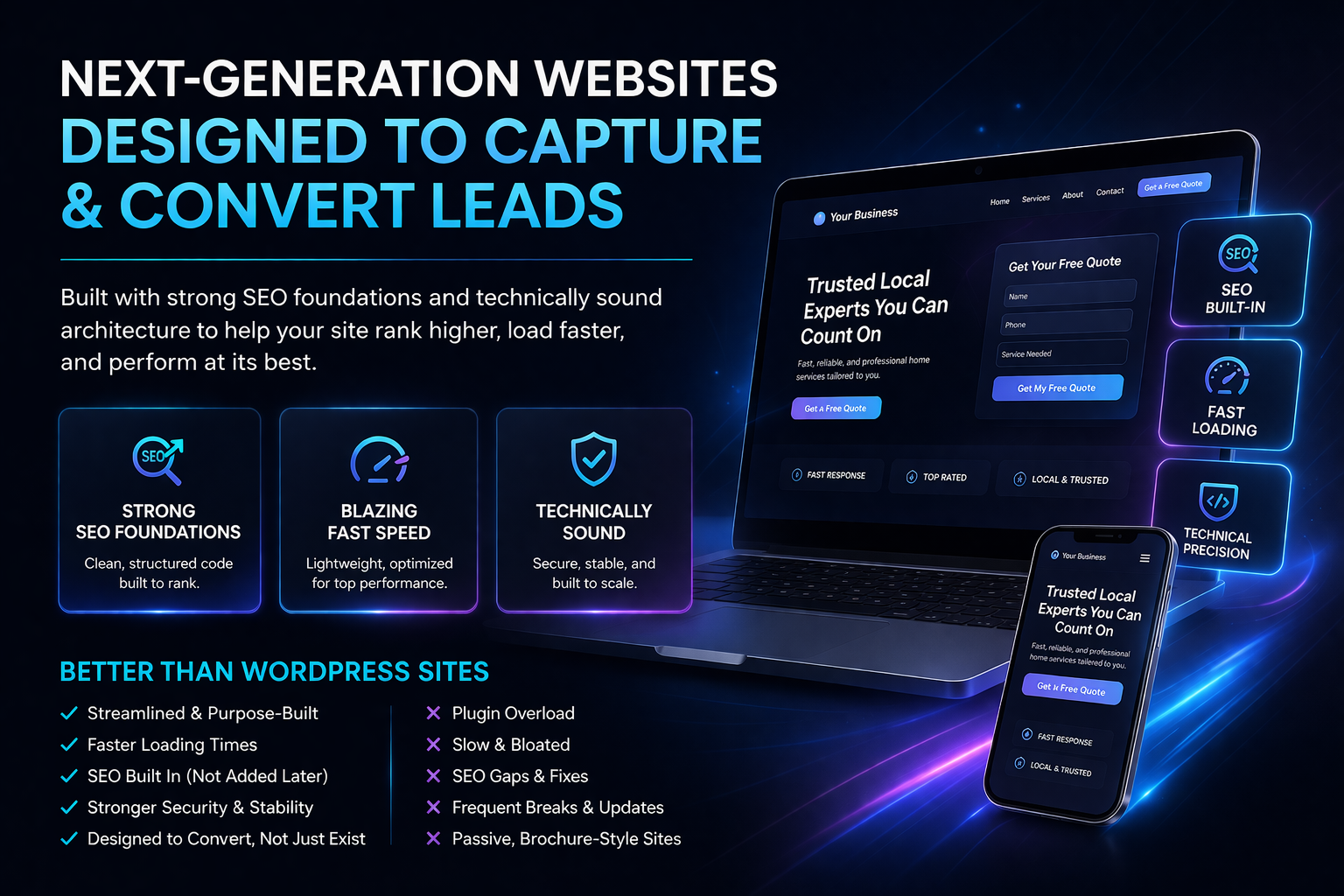
What I do at Resonating Brands is build websites and digital systems that work — not just websites that exist. There's a real difference, and service businesses that understand that difference are the ones pulling ahead right now.
If you're not sure where you stand, do those three searches I mentioned. Google your keyword. Ask Perplexity. Ask ChatGPT. Your answers will tell you everything you need to know about what needs to happen next.
Ready to upgrade from a DIY site? See how we build custom roofing websites engineered to rank, convert, and grow — or explore our digital marketing services.
Continue Learning: Local SEO Guide for Roofers · Roofing Website Conversion · GEO Guide · Roofing Marketing Strategies · Roofing Marketing Hub
Janette O'Shaughnessy is the founder of Resonating Brands, a digital agency specializing in next generation websites, local SEO, and lead generation for service businesses.