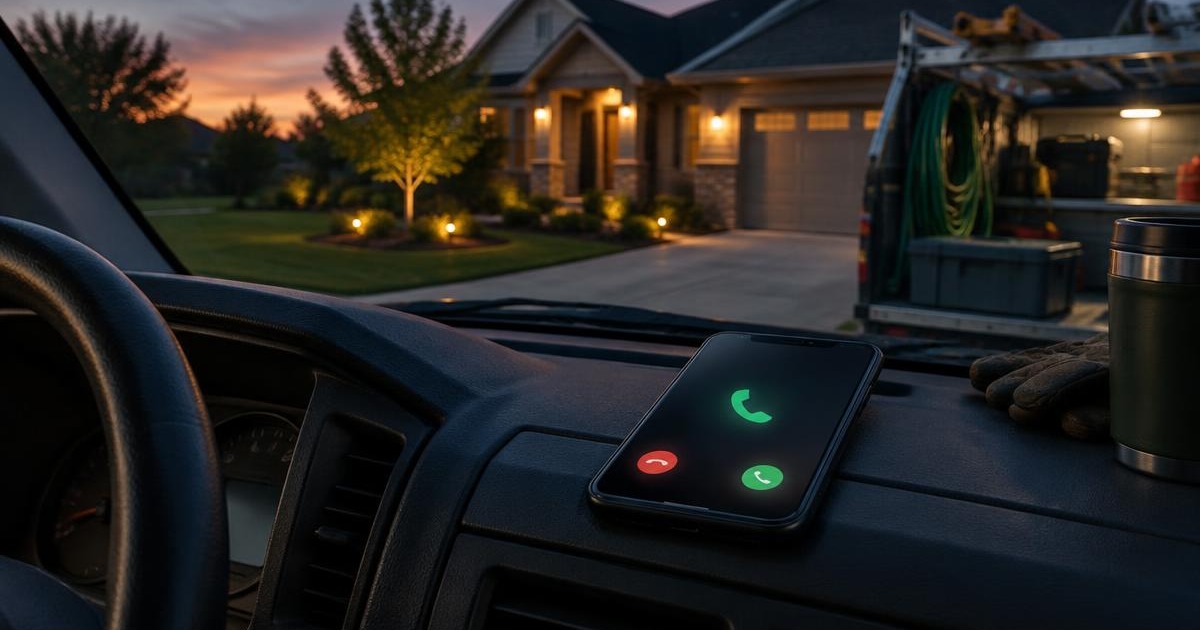
It's 9:12 on a Tuesday night in January. A homeowner's furnace just quit. The house is 58 degrees and dropping. She calls three HVAC companies.
The first one goes to voicemail. She doesn't leave a message.
The second one gets a live answering service. A friendly person takes her name and number and says someone will call her back in the morning.
The third one picks up, asks what's going on, figures out it's a no-heat call, checks the schedule, and books her for 7:30 the next morning. She gets a text confirming it before she hangs up.
Guess who gets the job.
This one is for roofers, HVAC companies, plumbers, electricians, tree services, and cleaning companies trying to decide what happens when the phone rings and nobody in the office can grab it. You have two real options now: a live answering service or an AI receptionist. They are not the same thing. And most contractors are comparing them the wrong way.
The short answer
An answering service takes a message. An AI receptionist can do the first five minutes of the job.
That's the whole difference. A live answering service is a person reading from your script. They're good at sounding warm. But in most setups, they can't see your schedule, can't book, and can't tell a real emergency from a tire kicker. You still have to call everyone back.
A well-built AI receptionist answers on the first ring, asks your qualifying questions, books the appointment in your calendar, texts the customer a confirmation, and transfers the real emergencies to your on-call tech. It doesn't get tired at 2 a.m. And it costs a fraction of a live service.
But AI is not the right answer for every call. I'll show you where it wins, where it doesn't, and how I'd set it up if it were my business.
Why this matters more than it used to
After-hours calls are the single biggest headache in the trades right now. In Scorpion's 2026 State of Home Services Marketing report, 66% of home service businesses said providing after-hours customer service was their top challenge. On the other side of the phone, 56% of homeowners said they want 24/7 scheduling or a way to reach a business after hours.
Read those two numbers together. Homeowners want to reach you at night. Most of you can't make that work. Somebody in your market is going to solve it, and they're going to take those jobs.
Here's the part that should sting. Invoca, a call tracking company, reported that 27% of calls to home services businesses go unanswered, and that fewer than 3% of callers sent to voicemail leave a message. That's Invoca's own platform data, so treat it as one company's view. But it matches what I hear from owners every week. Voicemail is not a plan. It's a lost job with a beep at the end.
And homeowners are more open to talking to AI than most contractors think. Housecall Pro surveyed 1,040 homeowners in late 2025. 53% said they're comfortable with AI handling an initial chat or phone call, as long as the experience is smooth and helpful. That last part is the catch. A bad AI experience is worse than a good voicemail. A good one books the job.
What each option actually does on a call
Here's the side-by-side I walk owners through.
| Voicemail | Live answering service | AI receptionist | |
|---|---|---|---|
| Answers every call | No | Usually, but callers can wait on hold | Yes, on the first ring, even five at once |
| Asks your qualifying questions | No | Yes, from a script | Yes, and it adapts to the answers |
| Books the appointment | No | Sometimes, only if connected to your calendar | Yes, if connected to your calendar or CRM |
| Sends a text confirmation | No | Rarely | Yes |
| Spots an emergency and transfers it | No | Yes, if the script covers it | Yes, if you set clear rules |
| Handles an angry or upset caller | No | Better than AI | Fair, and needs a fast handoff to a human |
| Handles a storm or heat wave spike | No | Gets expensive fast | Same price per minute, no hold times |
| Gives you a recording and transcript | No | Varies | Yes, every call |
The live service wins on one thing: human warmth when a caller is upset. AI wins on almost everything else.
What it costs in 2026
These are the published prices on each company's own pricing page as of November 2026. Prices change, so check before you buy. I'm not recommending any of these companies. I'm showing you the shape of the market.
Live answering services
| Service | Entry plan | Mid plan | How you're billed |
|---|---|---|---|
| PATLive | $99/mo for 50 minutes, then $2.29/min | $349/mo for 200 minutes, then $1.99/min | Per minute |
| Abby Connect | $164/mo for 50 minutes | $599/mo for 200 minutes | Per minute |
| Ruby | $250/mo for 50 minutes | $720/mo for 200 minutes | Per minute |
| Smith.ai (human-first) | $300/mo for 30 calls, then $11.50/call | $810/mo for 90 calls, then $10.50/call | Per call |
AI receptionists
| Service | Entry plan | Mid plan | How you're billed |
|---|---|---|---|
| Dialzara | $29/mo for 60 minutes, then $0.48/min | $199/mo for 500 minutes, then $0.40/min | Per minute |
| Rosie | $49/mo for 250 minutes | $149/mo for 1,000 minutes | Per minute |
| Goodcall | $79/mo for 100 unique customers | $129/mo for 500 unique customers | Per customer |
| Smith.ai (AI receptionist) | Free plan, $3/call | $150/mo for 75 calls | Per call |
Roughly speaking, a live service runs about $1.50 to $11.50 per minute or per call. AI runs roughly $0.10 to $3. That's a big gap, but the price tag isn't the real story. The real story is what happens when your phones get busy.
The storm week math
Say you get about 120 after-hours calls in a normal month, and each one lasts about three minutes. That's 360 minutes.
•Live service (PATLive's 200-minute plan): $349, plus 160 extra minutes at $1.99. That's about $667 for the month.
•AI receptionist (Dialzara's 500-minute plan): $199 for the month. Same calls, no overage.
Now a hailstorm rolls through, or the first heat wave of July hits, and your after-hours calls double to 720 minutes.
•Live service: $349 plus 520 extra minutes at $1.99. That's about $1,384.
•AI receptionist: you move up to the 1,000-minute plan at $349. Or you pay $0.40 a minute on the overage. Either way, you're well under $400.
The live service bill spikes exactly when you're busiest. The AI bill barely moves. And here's what the spreadsheet doesn't show: during a storm, a live service gets slammed by every contractor in your area at once. AI answers all of your calls at the same time. No hold music.
Where an AI receptionist wins
Emergency trades. HVAC no-heat and no-cool calls. Burst pipes. A tree on the garage. Active roof leaks. These callers need an answer now, and they will call the next company if they don't get one. AI answers on the first ring and can transfer the true emergencies to your on-call tech in seconds.
Booking routine work. Tune-ups, estimates, inspections, cleanings. These calls follow the same pattern every time. AI is great at patterns. It asks the questions, picks a time, books it, and texts a confirmation.
Volume spikes. Storm season for roofers. The first cold snap for furnace companies. Spring for tree services and landscapers. AI doesn't get overwhelmed.
Getting you the data. Every call is recorded and transcribed. You can see what people are actually calling about, which services are in demand, and which ad or Google listing sent them. A message pad from an answering service gives you a name and a number.
Where a live person still wins
I'm not going to pretend AI is perfect. It isn't.
Upset callers. Someone with water pouring through their ceiling at midnight, or a customer who's angry about a past job, wants a human. AI can stay calm, but it can't truly comfort someone. Build in a fast handoff for these calls.
Complicated situations. An insurance claim question. A commercial property manager with five buildings. A caller who isn't sure what's wrong. If the conversation goes off script, AI should take a detailed message or transfer, not guess.
Callers who don't want AI. Some people will hang up the second they realize it's not a person. Usually that's a small share, and many callers never notice. But if your customer base skews older, test it and watch your hang-up rate.
My recommendation: use both, in the right order
Here's how I'd set it up for most home service companies:
1.During business hours, a human answers first. Your office person or your CSR team. When they're already on the line, at lunch, or out of the office, calls roll to the AI instead of voicemail.
2.After hours and weekends, AI answers everything. It books routine work, takes detailed messages, and transfers true emergencies to your on-call tech.
3.Every emergency call goes to a human fast. No exceptions. The AI's job on those calls is to get the address, the problem, and a callback number, then connect the call.
4.You review the recordings every week. This is where most people get lazy. Don't. Listen to ten calls a week. You'll find the questions your AI fumbles and fix them.
If you already pay for an answering service and you like it, you don't have to fire them. Keep them for the overflow and the upset callers, and put AI on the after-hours shift. Then compare the booked jobs side by side for 60 days.
How to set up an AI receptionist that doesn't embarrass you
Most bad AI phone experiences come from bad setup, not bad technology. Here's what I check on every voice agent I build for a contractor.
Write your emergency rules first. Decide exactly what counts as an emergency for your trade, in plain words. For HVAC: no heat below a set indoor temperature, a gas smell (tell them to leave the house and call the gas company first), water leaking from the furnace or AC. For roofing: active water coming into the house. For plumbing: a burst pipe or no water. For tree work: a tree on a house, car, or power line (tell them to stay away from downed lines and call the utility). The AI needs clear rules, not judgment calls.
Tell it what it must never do. Never quote a price unless you've given it exact numbers. Never diagnose the problem. Never promise an arrival time it can't see on the schedule. Never say "24/7 service" if you don't actually offer it.
Give it your real information. Your service area towns, your hours, your services, what you don't do, your financing options, your warranty. If the AI doesn't know, it should say so and take a message. A wrong answer costs you more than "let me have someone call you."
Connect it to your calendar or CRM. An AI that can't book is just an expensive answering machine. If it can see your real schedule in ServiceTitan, Housecall Pro, Jobber, GoHighLevel, or Google Calendar, it can actually book the job.
Pick a voice that sounds like your company. Give it a name. Keep it friendly and short. Contractors' customers don't want a radio announcer.
Make 20 test calls before it goes live. Call as a confused homeowner. Call as an angry one. Call with a bad cell connection. Call about something you don't do. Have your spouse call. Fix what breaks.
Tell callers the call may be recorded. Put a short recording notice at the start of every call, AI or human. Several states, including California, Florida, Illinois, Pennsylvania, and Washington, require everyone on a call to consent to recording. Check your own state's rules with your attorney. This is a one-line fix that saves you a headache.
One more legal note people mix up. In February 2024, the FCC ruled that AI-generated voices count as "artificial or prerecorded" voices under the TCPA, which means you need prior consent before an AI calls someone. That rule is about outbound calls. An AI answering calls that customers make to you is a different situation. If you plan to have AI make outbound follow-up calls, talk to your attorney first.
Questions to ask before you sign up for anything
•Can it book directly into my scheduling software, or does it just send me a message?
•How does it transfer a call to my on-call tech, and what happens if the tech doesn't answer?
•Can I listen to every call and read every transcript?
•What happens when the caller asks something it doesn't know?
•Is there a contract, or is it month to month?
•What does a storm week cost me? Get the overage rate in writing.
•Who owns the call recordings and customer data if I leave?
If the salesperson can't answer those clearly, keep looking.
Frequently asked questions
What is the difference between an AI receptionist and an answering service?
A live answering service uses real people who follow your script, take messages, and pass them to you. An AI receptionist is software that answers calls with a natural-sounding voice, asks your questions, books appointments into your calendar, sends confirmations, and transfers emergencies. An answering service takes a message. An AI receptionist can complete the booking.
How much does an AI receptionist cost compared to an answering service?
As of November 2026, published AI receptionist plans start around $29 to $150 a month, and work out to roughly $0.10 to $3 per minute or call. Live answering services start around $99 to $300 a month, and work out to roughly $1.50 to $11.50 per minute or call. The gap gets wider in busy months, because live services charge overage by the minute or by the call.
Will customers hang up on an AI receptionist?
Some will. But in a December 2025 Housecall Pro survey of 1,040 homeowners, 53% said they're comfortable with AI handling an initial call or chat, as long as it's smooth and helpful. Good setup matters more than the technology. Keep the greeting short, answer questions directly, and transfer to a human fast when a caller asks for one.
Can an AI receptionist handle emergency calls for HVAC, plumbing, or roofing?
Yes, if you give it clear rules. The AI should collect the address, the problem, and a callback number, then transfer the call to your on-call tech right away. Write your emergency rules in plain words, like "no heat and the house is below 60 degrees" or "water is coming into the house," so the AI doesn't have to guess.
Should I replace my office staff with an AI receptionist?
No. Use AI to catch the calls your team misses: after hours, weekends, lunch breaks, and when everyone is already on the phone. Let your people handle the calls where a human touch wins the job, like upset customers and complicated quotes.
Is it legal to use an AI receptionist to answer calls?
Generally, yes. Play a "this call may be recorded" notice at the start, because some states require every party's consent to record. The FCC's 2024 ruling on AI voices applies to outbound robocalls, not to an AI answering calls customers place to you. If you plan to use AI for outbound calls, check with your attorney first.
The bottom line
The contractors winning the night aren't the ones with the biggest office staff. They're the ones who answer.
An answering service was the best option for a long time. For a lot of calls, it isn't anymore. An AI receptionist that's set up right answers every call, books the job, and hands your team the emergencies. A live person is still the best choice for the calls that need a human. Use each one where it wins.
Want to hear what an AI receptionist sounds like for your trade? At Resonating Brands, we build and manage voice agents for home service contractors, wired into your calendar and CRM, with emergency transfers set up the way you work. Contact us and we'll walk you through a live demo.
Want to go deeper? Read how AI voice agents help contractors capture more leads, why response time makes or breaks your sales, and capturing the leads that come in after hours.
Sources
•Scorpion, "Scorpion's new industry report reveals a disconnect", February 19, 2026
•Housecall Pro, "Home service customer service report: trends and statistics", December 10, 2025
•Invoca, "How much missed sales calls cost home services businesses", May 23, 2024
•Pricing pages, read November 1, 2026: PATLive, Abby Connect, Ruby, Smith.ai, Smith.ai AI Receptionist, Dialzara, Rosie, Goodcall
•FCC, "FCC makes AI-generated voices in robocalls illegal", February 2024
•Kilpatrick Townsend, "Wiretap laws in the United States", July 29, 2024
Janette O'Shaughnessy is the founder of Resonating Brands, a boutique digital marketing agency based in West Michigan that specializes in next generation websites, voice agents, and lead generation systems for home service contractors.