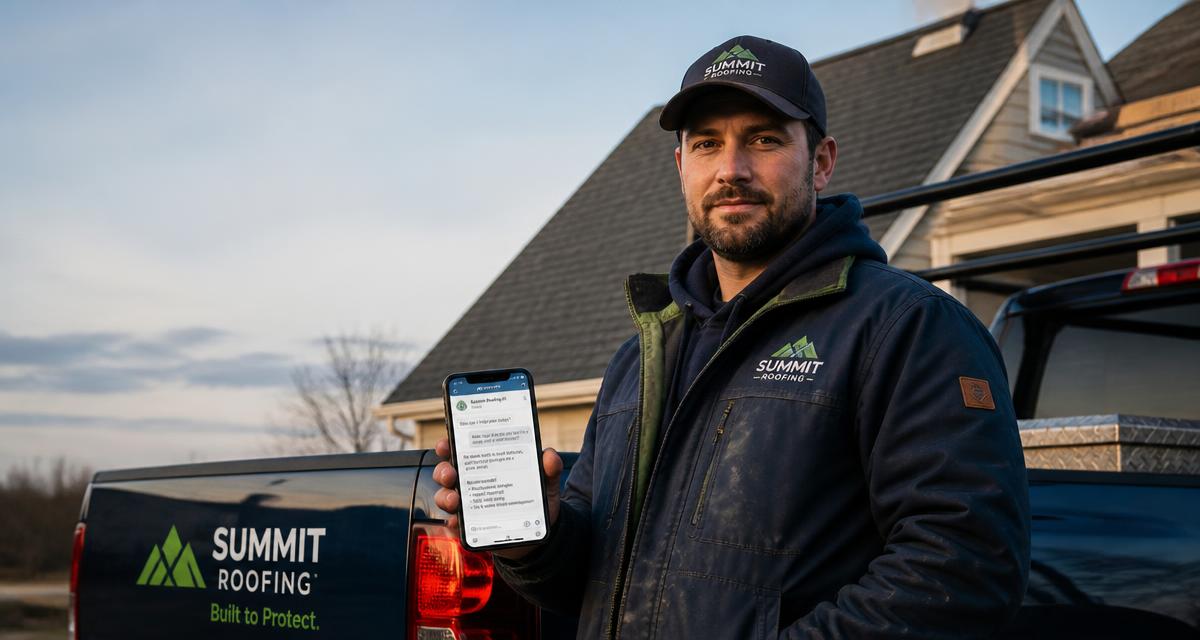
I've been sitting with roofing owners for months while they figure this out. What most of them want isn't a plan for the AI-native future. They want a straight answer to one question: if I have five hours and a small budget this month, where do I put it and what do I skip?
This is that answer. It is not a hype piece and it is not a hit piece. Every claim below is either from a primary source or from my own work with clients. Where the industry is split — and there are a few places where it is — I'll say so and quote both sides.
Where Roofers Actually Are With AI Right Now
The two big roofing surveys landed within weeks of each other and they tell the same story from opposite ends.
Roofing Contractor's 2026 State of the Industry survey put AI use among roofing contractors at 40% in 2025, up from 29% in 2024. Another 36% said they were "discussing AI implementation over the next two years," and the share saying they have no plans to adopt AI at all dropped from 32% to 9% (The Roofing Brief).
ServiceTitan's 2026 Roofing & Exteriors Market Report, based on 1,018 roofing-focused companies surveyed by Thrive Analytics October 14–31, 2025, put the number differently: 25% of roofing and exteriors firms are using external LLM tools like ChatGPT or Gemini, and only 4% have AI built into their CRM. Their headline: "79% of roofing and exteriors contractors are not using AI or external LLMs" (ServiceTitan).
Both are correct. Roofing Contractor asked about "any use" of AI. ServiceTitan asked about specific deployments. What that gap tells you is that plenty of roofers have opened ChatGPT and asked it to write an email, but very few have wired AI into a workflow that reliably makes them money.
Which brings us to the number that actually matters. Across all trades ServiceTitan surveyed, only 12% have AI embedded in daily operations, 44% are blocked on training, and 44% are blocked on integration (ServiceTitan). Employee resistance was only 18%. The problem isn't that roofers are anti-AI. The problem is that the tools don't fit and nobody has time to figure out how to wire them in.
A trades-marketing writeup summarized the Reddit threads well: "Contractors aren't anti-AI. They're anti-nonsense... Nobody wants another dashboard. Nobody wants to spend thirty days learning a new platform" (Raise the Trades).
Keep that at the front of your mind. If a tool doesn't cut a real cost, book a real job, or answer a real phone within the first two weeks, kill it.
The Four Places AI Is Genuinely Working for Roofers Today
I'm going to give you the honest ranking. The order is what pays back fastest for a typical residential roofing company under $10M in revenue. Larger commercial and restoration shops will have different priorities — I'll flag those.
1. Answering the Phone
This is the single highest-ROI place to start for most roofing companies, and it's not close.
The pain is unambiguous. Trade press estimates that "up to 30%" of calls go unanswered during peak season (Roofing Contractor). Owners describe being on a roof while the phone cooks in the truck: "By the time he comes down for a break or finishes his day, he often finds several missed calls with no voicemails or context... many potential clients have already moved on to the next available roofer." ServiceTitan's data shows 67% of contractors reply to leads within four hours; the remaining third are handing those leads to whoever picked up (The Roofing Brief).
The pricing math for an AI receptionist versus other options is the clearest ROI case in this whole article. From an industry breakdown published in 2026:
| Option | Base cost | Storm-week cost |
|---|---|---|
| Flat-rate AI phone agent | From $29/month | ~$29 — surge doesn't change the bill |
| Per-call hybrid service | From ~$97/month | ~$450 |
| Per-minute live receptionist | $235–$325/month | ~$850 (overage can hit $700–$1,200) |
AI is the only one of the three whose price doesn't spike when the storm rolls in — which is exactly when you can't afford to lose calls (oncallclerk).
That doesn't mean you should turn every call over to AI. Roofers are split on it, and the objections are legitimate:
•"If I reach out for roofing services and have to navigate through frustrating AI systems on the phone, I'll just choose to go with a different company" (r/RoofingSales)
•"People do business with people. My business is a business, not a vending machine" (r/smallbusiness)
•Older customers hanging up on voice agents is a documented failure mode in home services
The operator counterpoint in the same thread as the first quote: "We did over 2000 calls... only 3 people asked if it was AI."
My honest recommendation: don't replace your human receptionist. Use AI to answer calls your humans miss — after hours, during storm surges, when your one office person is already on another line. That's the deployment where the numbers actually work and the customer experience holds up. Every AI phone tool I've reviewed can be configured this way, and it takes the ethical question off the table because your everyday customers still get a human.
One trap to avoid: every mainstream CRM now includes an AI voice option, and standalone tools start at $29 to $50 a month. If you're already paying for a CRM, check what you own before you buy something new. As one roofer put it: "Every CRM now provides this for $30 per month... It would be foolish to develop one on your own."
2. Aerial and Photo-Based Roof Measurement
This is the roofing-specific AI category that has actually shipped and works. Fifty-four percent of roofing contractors use drones and 51% use aerial measurement tools (The Roofing Brief).
The 2026 pricing landscape, from The Roofing Brief's independent report, is worth having in front of you:
| Tool | How it captures | Price | Claimed accuracy |
|---|---|---|---|
| EagleView | Plane-captured oblique imagery + computer vision | $15–$87 per report | 98.77% (CompassData, June 2025) |
| Hover | Smartphone photogrammetry, ~8 user photos | Pay-per-scan or $99/mo, $999/yr | 97.74% floor accuracy |
| RoofSnap | Nearmap + Hexagon aerial hybrid | $9 Half Snap, ~$16 Full Snap | Vendor-reported |
| GAF QuickMeasure | Aerial | From $18 for GAF-certified | Vendor-reported |
Vendor accuracy figures are vendor-reported. Field reality is somewhat wider. Hover users on Reddit have described 2–5% error, up to 8–10% on large roofs. Estimators outside roofing report 8–12% error on AI takeoffs and argue that "verifying the output defeats the time savings."
Both things are true at once. The tools are accurate enough for bidding and material ordering on typical residential roofs. They are not accurate enough that you can hand a homeowner a signed contract without a human checking the report. An independent 20-roof test in 2026 confirmed the vendor benchmarks broadly hold on standard residential — average deviations of ±1.2% on area and ±0.8° on pitch — but the sample was small and the test says nothing about complex commercial or old, heavily-shaded roofs (Roof Manager).
A few practical points that don't show up in the vendor decks:
•Aerial imagery goes stale.: Rural and new-construction areas can be 12–18 months out of date on Nearmap and Hexagon. Verify the imagery date before you quote.
•Xactimate ESX export is a gap on some platforms.: If you do supplement work, hand-keying the report into your claim workflow eats the time savings you thought you were buying.
•If you fly your own drone commercially, you need an FAA Part 107 certificate.: That is not optional.
The pattern I recommend: use an aerial measurement report for the bid, keep a drone for close-up documentation on any storm or claim job, and verify slope and edge details in person before you sign anything complex.
3. Writing, Research and Homeowner-Facing Content
This is where the largest number of roofers are already getting real value, and it doesn't require a purchase. The 25% of roofing and exteriors firms using external LLM tools like ChatGPT and Gemini are mostly using them for:
•Drafting proposal copy, project narratives and estimate write-ups
•Rewriting service pages and blog posts for their websites
•Turning field notes into a homeowner-readable inspection summary
•Answering "what is my policy language actually saying" questions from customers
•Explaining a complex repair scope to a homeowner in plain English
ServiceTitan's report attributes 59% of current AI usage to administrative tasks and 51% to marketing and sales, across all trades (ServiceTitan). That maps to what I see on client sites too.
A few honest rules for using ChatGPT and Claude in a roofing business:
Never let AI invent a fact. This is the one absolute rule. LLMs are pattern-completion machines. They will happily write a paragraph that sounds like an expert but contains a made-up code reference, a wrong slope calculation, or an installation detail that voids a warranty. A good storm-supplement AI prompt tells the tool explicitly: "Use only the observations I give you. Do not add, invent, or exaggerate any damage. If something is unclear, leave it out or mark it 'verify on site'" (FindSkill).
Don't let AI do math on a job. As one estimator put it plainly: "If you ask ChatGPT to calculate a cylinder volume in metric, it will give you wrong result." Use measurement software for measurements. Use AI for words.
Treat AI output as a first draft, not a final answer. If you are using AI to write a service area page or a blog post, you edit it. Your name goes on it. You are responsible for every claim in it, including the ones the AI slipped in without asking.
Understand what happens to what you paste. Construction attorney Trent Cotney has been direct about this: "I have subpoenaed ChatGPT history before... All of that is saved. Even if you delete it, it's there" (RoofersCoffeeShop, "Unpacking AI"). Do not paste customer PII, insurance claim numbers, or policy language into a free consumer LLM. If you need to do that kind of work, use a paid tier with a data-processing agreement and history disabled, or use a purpose-built roofing tool that has already sorted out the data handling.
4. Getting Cited by AI Assistants When a Homeowner Asks
This one has moved fast in the last twelve months, and it deserves its own detailed article — I wrote one, Homeowners Are Finding Roofers Through ChatGPT. Here's How to Be the One It Names. Short version for this pillar:
Homeowners are starting to ask ChatGPT, Perplexity and Google's AI Overviews for roofer recommendations. The businesses that get named are the ones with:
•A website AI tools can actually read (server-rendered, not a client-rendered SPA that returns an empty shell to bots)
•A complete Google Business Profile with lots of recent reviews
•Third-party mentions — local news, chamber listings, supplier certification pages, "best roofers in [city]" roundups
•Clean, direct answers to real customer questions on their own site
Being the #1 Google result does not automatically get you cited by ChatGPT. Ahrefs found only about 12% of chatbot citations come from pages ranking in Google's top 10 (Ahrefs). Those are two separate projects now.
If your website was built with a modern AI website builder (Lovable, v0, Bolt, Base44, Replit), you need to check specifically that the pages ship real HTML content and not just a JavaScript shell. Lovable rolled out server-side rendering by default for new projects on May 13, 2026 and has an in-place upgrade path for older projects. Vercel's v0 has been server-rendered by default for longer. Some of the others still ship as SPAs that render in the browser — which means AI assistants literally cannot read them.
Where the Industry Is Honestly Split, and Why
Two areas deserve more nuance than the marketing content typically gives them.
Insurance Claims: The AI Arms Race
Insurance carriers have quietly weaponized AI against homeowners and, by extension, against the roofers who represent them. State Farm, Allstate, Farmers, and Nationwide contract CAPE Analytics and Nearmap to pre-screen roofs from satellite and drone imagery, run computer vision against them, and issue non-renewals or claim denials without ever sending an inspector (Startup Basket).
The failure mode is well-documented and it is not just contractor complaint noise. Regulators are seeing it too. The Pennsylvania Insurance Department investigated consumer complaints and told insurers in Notice 2024-06 that "absent unequivocal damage in the image, a physical inspection is the prudent next step." Colorado's Bulletin B-5.57, issued March 16, 2026, warns that aerial imagery "requiring significant enlargement or inference may need verification by physical inspection" and that "a streaked but sound roof is not a failing roof, and a tarp over a repaired section is not neglect." Louisiana's Act 151 of 2024 prohibits insurers from relying solely on aerial images to justify a cancellation or nonrenewal unless the images are within 24 months (Insuro AI).
A New York Post story from March 2026 documented a homeowner facing a $20,000 bill after State Farm dropped their policy based on a drone flyover. An insurance advocate quoted in the piece said: "We are still encountering instances where drones and AI reach incorrect conclusions based on what they observe" (NY Post).
What this means for you, practically:
1.Document more, not less, on every storm claim job. — Ground-level, aerial, close-up (5–10 feet), video with GPS timestamp. The insurance industry advice for 2026 is essentially: overdocument or lose ([Roof Predict](https://roofpredict.com/blog/roofers-adapt-as-major-carriers-tighten-claims-procedure)).
2.If a homeowner comes to you with a non-renewal or denial based on aerial imagery, — they can request the specific reason and a copy of the imagery in writing. In states with an applicable bulletin or statute, they can cite it and demand the dispute process.
3.Never let AI invent damage in a supplement narrative. — The same algorithm the carrier used to flag "no storm damage" can be used to flag "out of pattern" supplements, and a vague, copy-pasted narrative is the easiest thing in the world for an algorithm to bounce.
AI-Generated Leads and "AI SEO" Agencies
A lot of the AI conversation in roofing right now is being driven by agencies trying to sell you something. Some of it is real. Some of it is not.
What is real: homeowners are asking ChatGPT for roofer recommendations, and being cited matters. What I laid out in the "getting cited" section above is the work that actually moves that needle.
What is not real, or at least not what it claims to be:
•llms.txt files sold as an AI visibility service.: Google's John Mueller: "FWIW no AI system currently uses llms.txt" (Search Engine Roundtable). It's a five-minute file. Fine to add. Not worth a subscription.
•Schema markup sold as an AI citation booster.: Ahrefs ran a controlled experiment on 1,885 pages that added JSON-LD, matched against three control pages each. The result was a small statistically significant decline in AI Overviews citations, and no meaningful lift on AI Mode or ChatGPT. Their conclusion: "Adding schema produced no major uplift in citations on any platform" (Ahrefs). I still put schema on every roofing site I build because it earns classic rich results. "It'll get you cited by ChatGPT" is not a reason to pay extra.
•"40% AI visibility boost" pitches.: That number comes from a real academic paper on generative engine optimization, but the follow-up review of 45 studies found that the gains "are valid within its experimental setting but conditional on a source already being present in a fixed context." Translation: it improves how AI cites content that's already been handed to it. It doesn't get you found in the first place.
The trade press has caught on. As one roofer summarized in a marketing session: "don't fall for all this crap like people talking about AEO and GEO." The underlying discipline is real. The way it's being sold often is not.
The Mistakes I See Roofers Make With AI
Five patterns I see repeatedly on client engagements:
1.Buying a tool before defining the problem. — "We need an AI strategy" is not a problem. "We missed 47 calls last week and I know because our answering service invoice showed the overflow" is a problem. Start from a number that is costing you money.
2.Signing up for tools that overlap with your CRM. — Roofers report tallying "$700 on various subscriptions"; a $6M Pennsylvania roofer reports "spending around $5,000 monthly with various add-ons, and I don't think it's worth the investment." Before you buy an AI receptionist, an AI email writer, or an AI CRM assistant, check what your current stack already includes. Most of them now include a version of all three.
3.Letting AI touch the customer without a human check. — I saw a Read Laboratories case study where a contractor let AI-generated measurements auto-populate a quote. The tool misidentified a complex chimney flashing as a standard vent. The quote went out $1,200 low ([Read Laboratories](https://readlaboratories.com/guides/ai-mistakes/roofing-companies)). Whether the AI in question is a measurement tool or a proposal writer, put a human approval step between it and the homeowner.
4.Pasting private data into free consumer LLMs. — See the Cotney quote above. If you are working on claim documentation, use tools purpose-built for it or paid tiers with clear data-handling terms.
5.Ignoring the phone. — If I could make every roofer reading this do one thing, it would be to install some form of AI or human backup for missed calls before they invested a dollar in any other AI tool. It is the biggest leaky bucket in the industry, and it's the cheapest to fix.
The 30/60/90 I'd Actually Run
If you're starting from zero, this is the sequence I'd use with a client this quarter.
Days 1–30: Stop Losing What You Already Have
1.Pull a month of call logs. Count the missed calls. Multiply by your average job value and your close rate. That's your leaky bucket. If it's over $10,000 a month, you should have an AI or hybrid answering solution running by day 15.
2.Audit what your current CRM already includes. If you're paying for a CRM that has an AI voice or auto-response feature you're not using, turn it on before buying anything new.
3.Paste your top three service page URLs into ChatGPT and ask it what services you offer and where. If it can't read the page back accurately, your site is invisible to AI recommenders. That's your top website fix.
Days 31–60: Give One Workflow to AI
1.Pick one narrow use case: proposal writing, inspection summary drafts, service-area page drafts, or homeowner damage explanations. Pick one, not four.
2.Write yourself a system prompt that spells out what AI can and can't do — including "invent nothing" — and use it every time.
3.Run one week of manual "AI search" checks: ask ChatGPT, Perplexity, and Google's AI Mode the five questions your customers actually type. Note who gets recommended and why. That's your competitive gap.
Days 61–90: Measure and Expand Cautiously
1.Compare your closed-job count and lead-response time to the prior 60 days. If the missed-call fix and the one workflow paid back, add a second workflow. If they didn't, stop and fix before adding.
2.Add aerial measurement software if you haven't already, and integrate it with your estimate workflow. Even at $16–$25 a report, this pays for itself on a single mis-measured job.
3.Revisit your website. If Lovable, v0 or a similar builder made your site, verify it's on the server-rendered stack (see my ChatGPT-citations article for the specific test). Fix if not.
What I'd Tell You if You Called Me
Every roofer I've helped through this has landed in roughly the same place. The framework isn't complicated:
•Answer the phone.: This is 80% of the near-term ROI.
•Measure the roof with software.: This is table stakes now.
•Use AI to write faster, not to think for you.: Never let it invent a fact.
•Get cited by AI assistants: by doing the boring things — reviews, earned mentions, a site AI can actually read.
•Stop paying for anything sold as an "AI SEO booster": until you've done the boring things.
The 79% of roofers who aren't using AI aren't stupid or scared. Most of them are just busy running a business, and every tool that has crossed their desk so far demanded thirty days of learning to get five minutes of value. If a tool doesn't cut a real cost, book a real job, or answer a real phone within two weeks, kill it. That single rule will save you more money than every AI blog post you'll read this year, mine included.
Your one action this week: pull last month's call log and count the calls your team missed. If the number is more than 10, that's where you start. Everything else can wait.
If you want a second set of eyes on any of this, we build next generation websites and search systems for roofing and home service companies, and we'll tell you the truth about what's working.
Book a free strategy session →
Sources
•The Roofing Brief, "Roofing Technology Adoption (2026): Drones & AI Data" — theroofingbrief.com
•The Roofing Brief, "2026 Aerial Roof Measurement Software Report" — theroofingbrief.com
•ServiceTitan, "AI in the trades: insights from 1,000+ contractors" — servicetitan.com
•ServiceTitan, "2026 Roofing and Exteriors Market Report" — servicetitan.com
•Roofing Contractor, "11 ways to use AI in your roofing business" — roofingcontractor.com
•Roofing Contractor, "Report: Contractors See AI Driving Efficiency Gains" — roofingcontractor.com
•oncallclerk, "How Much Does a Roofing Answering Service Cost? (2026)" — oncallclerk.com
•Roof Manager, "AI Roof Measurement Accuracy: 2026 Independent Test Results" — roofmanager.ca
•FindSkill, "No, AI Won't Replace Roofers — But It Might Deny Your Claim" — findskill.ai
•Insuro AI, "AI in Homeowners Insurance: State Rules (2026)" — insuro.ai
•New York Post, "State Farm flew a drone over my house" — nypost.com
•Startup Basket, "RoofRebut — AI counter-evidence for roofers vs insurer denials" — startupbasket.ai
•Roof Predict, "Roofers Adapt as Major Carriers Tighten Claims Procedure" — roofpredict.com
•Raise the Trades, "What Contractors on Reddit Actually Think About AI" — raisethetrades.com
•RoofersCoffeeShop, "Unpacking AI" — youtube.com
•Read Laboratories, "AI Mistakes Roofing Companies Should Avoid" — readlaboratories.com
•Ahrefs, "Does Schema Markup Increase AI Citations?" — ahrefs.com
•Ahrefs, "AI Search Overlap with Google Rankings" — ahrefs.com
•Search Engine Roundtable, "Google's John Mueller on llms.txt" — seroundtable.com
•Reddit: r/Roofing, r/RoofingSales, r/estimators, r/AIVoice_Agents, r/AiForSmallBusiness, r/smallbusiness
Janette O'Shaughnessy is the founder of Resonating Brands, a boutique digital marketing agency based in West Michigan that specializes in next generation websites, voice agents, and lead generation systems for home service contractors.
Continue Learning: Homeowners Are Finding Roofers Through ChatGPT · Roofing Marketing Hub · What Is SEO and Why Do I Need It?