By Janette O'Shaughnessy, Founder, Resonating Brands
Something interesting has been happening in search. More and more people are skipping the list of blue links and typing their questions directly into ChatGPT, Google's AI Overviews, or tools like Perplexity. They ask: "Who is the best roofer in my area?" or "How much does a roof replacement cost?" — and they get a direct, conversational answer right back.
This shift has sparked a question I'm hearing more and more from business owners: "Do I even need a website anymore? If AI is just going to answer for me, what's the point?"
The short answer is: yes, you absolutely still need a website. But more importantly, your website has never mattered more. Here's why.
First, Let's Talk About What's Actually Changing: GEO and AEO
You may have heard the terms GEO (Generative Engine Optimization) and AEO (Answer Engine Optimization) floating around. These are not just buzzwords. They represent a real shift in how businesses need to think about showing up online.
AEO means optimizing your content so that AI tools — like ChatGPT, Google's Bard, or Siri — can pull from it to answer questions directly. Instead of a user clicking through to your site, the AI reads your site and uses what you've written to craft its response. Your FAQ page, your service descriptions, your blog posts — these become the raw material for AI-generated answers.
GEO is the broader practice of making sure your business shows up in AI-generated search results. Google now generates AI summaries at the top of many search pages. These summaries pull information from websites that Google deems authoritative, well-structured, and relevant. GEO is about making your website "AI-readable" so it gets chosen as a source.
The businesses that get recommended by AI are the businesses that give AI something clear and trustworthy to read.
How Do These AI Tools Actually Work?
To understand why your website still matters so much, it helps to understand how AI tools like ChatGPT actually learn and answer questions.
AI tools like ChatGPT, Google Gemini, and Perplexity are powered by what's called a Large Language Model, or LLM. Think of an LLM like an incredibly well-read student who spent years reading virtually everything published on the internet: websites, books, articles, Wikipedia, forums, product reviews, local business listings, and more. During a process called "training," the AI reads billions of words and learns the patterns of how language works and how ideas connect.
After training, that student now carries an enormous internal library of knowledge. When you ask it a question, it doesn't go look something up — it draws on everything it has already learned. This is why AI tools can answer questions so quickly, and why they sometimes sound very confident even when they're wrong: they're working from a snapshot of the world that was captured at the time they were trained.
Where Do LLMs Get Their Information?
This is the part that matters most for business owners. LLMs gather their knowledge from four main places:
•Websites.: Billions of them. Everything from major news sites down to individual business websites, local blogs, and industry directories. If your business has a website with clear, well-written content, it can become part of what the AI knows about your company, your services, and your industry.
•Books and published articles.: Academic papers, how-to guides, industry publications — all of this feeds into the AI's base knowledge.
•Forums and reviews.: Platforms like Reddit, Yelp, Google Reviews, and industry Q&A sites give AI a sense of what real customers say and ask about businesses like yours.
•Structured data sources.: Wikipedia, schema-marked-up web pages, and online directories like Google Business Profile are especially valuable because they present information in clean, organized formats that AI can easily parse.
There's also a second layer that many people don't realize: real-time web search. Many AI tools — ChatGPT with its browsing feature, Perplexity, Google's AI Overviews — don't just rely on what they learned during training. They actively search the web at the moment someone asks a question. When that happens, they are crawling and reading current websites, right now, to build their answer.
If your website doesn't exist, or it's thin and outdated, there's nothing for AI to read. You become invisible — not just to search engines, but to AI.
So Why Does Your Website Still Matter?
Your website is the source. It is the place where authoritative, accurate information about your business lives. It's what AI reads — whether during its training phase or in real-time searches. And it's what Google evaluates when deciding whether to feature your business in an AI Overview.
Think about what happens when someone asks an AI: "Who is a reliable roofing contractor in Grand Rapids?" The AI is going to look for signals that a business is legitimate, experienced, and well-regarded. Those signals come from websites. A site with detailed service pages, a strong FAQ section, clear location information, customer reviews integrated or linked, and properly structured content is far more likely to be cited by an AI tool than a business with no web presence at all.
Your website also gives you something that no social media profile or directory listing can: complete control over your message. Facebook can change its algorithm tomorrow. Google Business Profile has strict limits on what you can say. Your website is yours. It's where you get to tell your full story, on your own terms, in a format that both humans and AI can understand.
The Practical Takeaway for Service Businesses
If you are a service business — a roofing company, a plumber, a landscaper, a contractor of any kind — here is what this all means in plain terms:
•A website with clear, well-written service pages makes you findable by AI when someone asks a relevant question.
•A well-structured FAQ page answers the exact questions people type into AI tools, increasing the chances AI uses your content as its source.
•Location-specific content (mentioning the cities and neighborhoods you serve) helps AI connect you with local search queries.
•Schema markup — a technical layer added to your site's code — makes your information even easier for AI to read and categorize correctly.
•Regular, fresh content signals to both search engines and AI that your business is active and current.
None of this replaces good service or strong reviews. But it creates the digital foundation that makes everything else work — including AI-powered visibility.
The Bottom Line
GEO and AEO are not replacements for having a website. They are new practices built on top of it. The businesses that will thrive in an AI-driven search environment are the ones that have invested in clear, credible, well-structured web content. The businesses that will get left behind are the ones that assumed a Facebook page was enough.
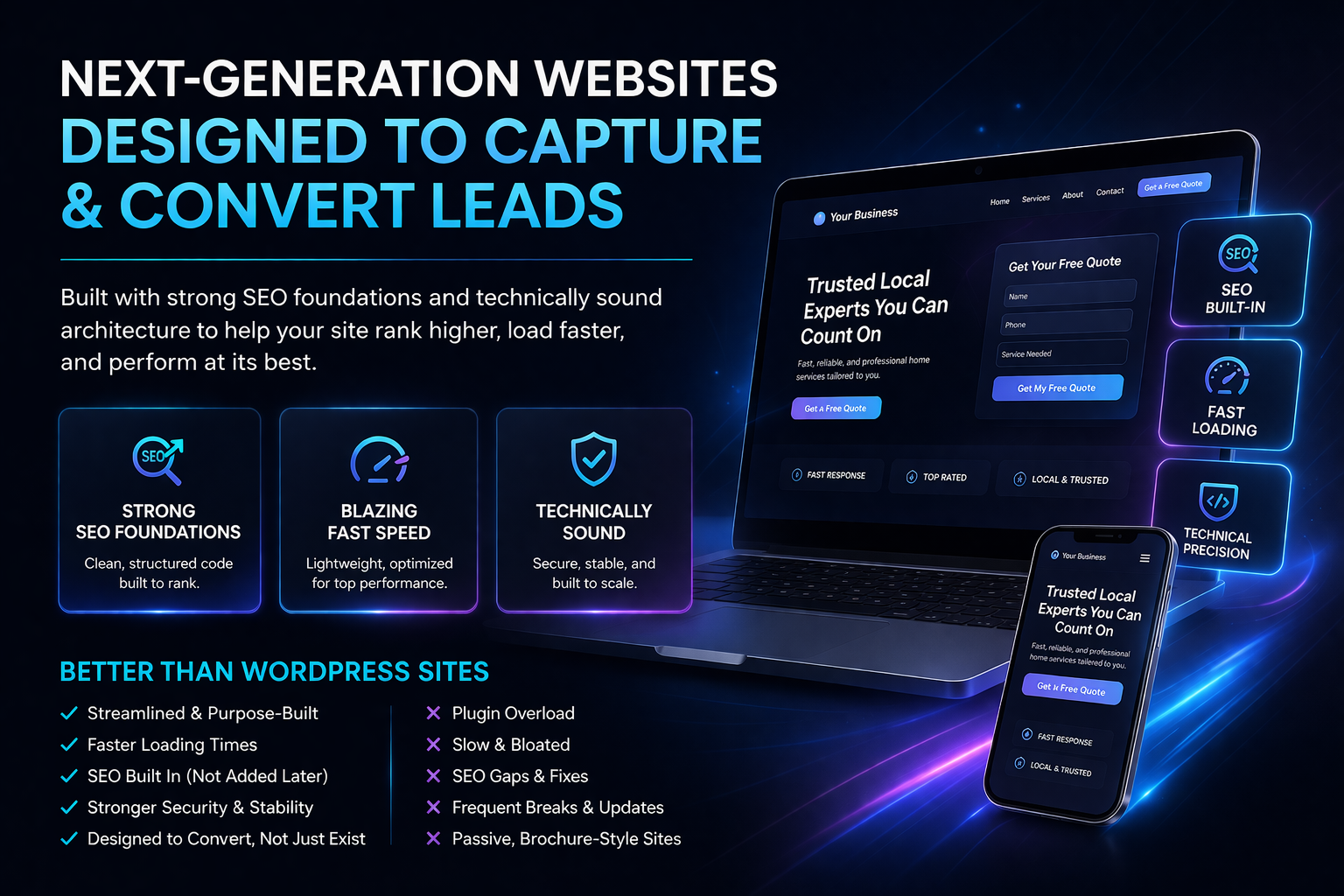
At Resonating Brands, we build websites designed to work for both human visitors and AI systems. That means clean architecture, authoritative content, local SEO foundations, and the technical signals that help AI tools recognize your business as a trustworthy source. It is not magic. It is good strategy, applied consistently.
If you're wondering whether your website is ready for the AI era, we'd love to talk. The bar for showing up in AI search is not impossibly high — but it does require having something real for AI to find.
Ready to build a website that works for AI and humans alike? Contact Resonating Brands today — we'll take a look at where you stand and show you exactly what it takes to show up.
Continue Learning: Roofing Marketing Hub · GEO Guide for Roofers · Why Isn't the Phone Ringing? · Local SEO for Roofers · Roofing Marketing Strategies · Websites for Home Services