A Deep-Dive Q&A by Janette O'Shaughnessy
The Foundation: Mindset and Systems
Q: I feel like some roofing companies always have a full pipeline no matter what the season or the weather does. How are they doing it while I'm constantly chasing the next job?
This is the question I hear more than almost any other from roofing contractors — and it's the right question to be asking. Because the gap between a roofing company that scrambles for work and one that has a predictable, consistent flow of inbound leads is not luck. It's not a better territory. It's not even necessarily a bigger budget. It's a system.
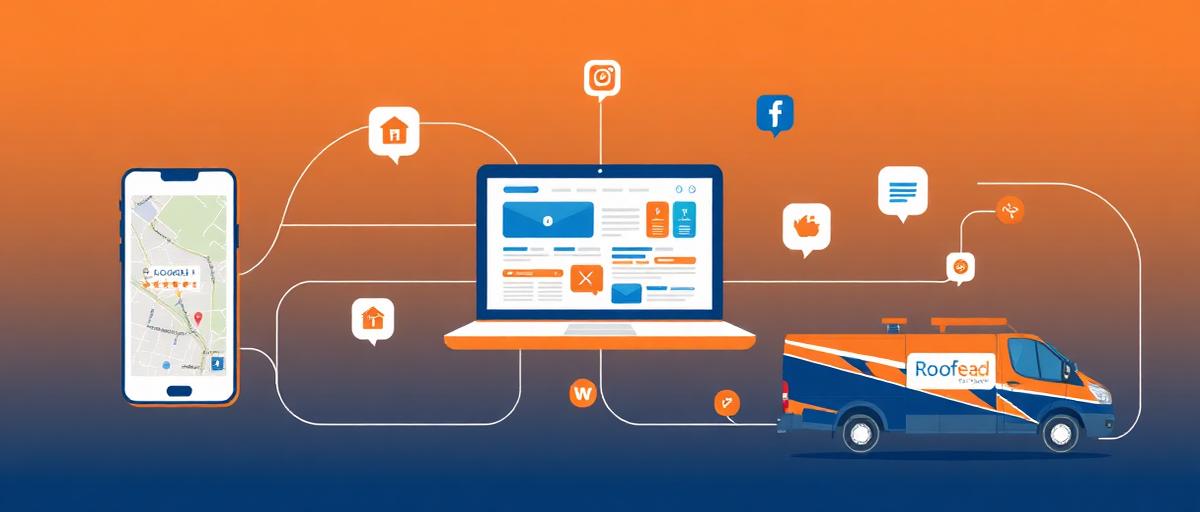
The roofing contractors who seem to always have work have built what I call a lead generation ecosystem — a set of interconnected strategies that work together, reinforce each other, and compound over time. They're not doing one thing well. They're doing several things consistently, and those things are feeding each other in ways that make the whole greater than the sum of its parts.
In this article I'm going to take you inside exactly what those roofing companies are doing — the strategies, the tactics, the mindset, and the infrastructure — so you can understand not just what to do, but why it works and how to build it for yourself.
Q: Is consistent lead generation really achievable for a roofing company, or does it always come down to storm cycles and seasonality?
Storm cycles and seasonality are real — I'm not going to pretend they don't affect roofing volume. But the roofing contractors who depend entirely on storms and warm weather for their business have built themselves a ceiling. They're reactive. They boom when conditions are right and starve when they're not.
The companies with truly consistent leads have made a fundamental mindset shift: they stopped thinking of lead generation as something that happens to them and started treating it as something they actively build and manage. They run their marketing the same way they run their operations — with systems, metrics, and accountability.
Here's the key insight: consistency in lead generation comes from diversification. No single lead source — not Google, not referrals, not door knocking, not paid ads — is reliable enough on its own. The contractors with full pipelines are pulling leads from multiple channels simultaneously, so when one channel slows down, others pick up the slack.
Let's go through every channel that the most successful roofing companies are using right now.
Channel One: Organic Search and SEO
Q: I keep hearing about SEO. How much does it actually contribute to consistent roofing leads?
For contractors who have invested in it properly and consistently, organic search — meaning leads that come from Google without paying for each click — is often their single largest and most profitable lead source. The reason is economics: once you're ranking, the leads essentially cost you nothing per inquiry. You're not paying $80 to $200 per click like you would in Google Ads. The traffic comes in around the clock, seven days a week, whether you're on the job or sleeping.
The challenge is that SEO takes time to build and requires sustained effort to maintain. But the contractors who started investing in it two or three years ago are now sitting on a compounding asset that their competitors can't easily take away.
What does proper roofing SEO look like? At its core, it means:
•Ranking for high-intent local keywords.: "Roof replacement [city]," "roofing contractor near me," "emergency roof repair [city]," "hail damage roof [city]" — these are searches made by homeowners who are ready to buy, not just browsing. Ranking for these terms is where the leads come from.
•Ranking for research-phase keywords.: "How much does a new roof cost," "signs I need a new roof," "how long does a roof last," "what to do after hail damage" — these searches happen earlier in the decision process, but the homeowners making them are on their way to needing a roofer. Capturing them at this stage builds brand familiarity and trust before they ever make a call.
•Publishing content consistently.: The roofing companies dominating organic search have websites with real depth — dozens of pages covering services, service areas, cost guides, FAQs, and educational content. Google rewards expertise and comprehensiveness. A five-page website cannot compete with a forty-page website that genuinely answers what homeowners are asking.
•Building local authority over time.: Backlinks from local organizations, supplier websites, industry directories, and community pages signal to Google that your business is a legitimate, established part of your local market. This authority is what separates page-one rankings from page-three obscurity.
The contractors getting consistent organic leads didn't build that overnight. But every month they invested in SEO is a month their competitors who didn't are now behind.
Q: What about AEO and GEO — how are the most forward-thinking roofers using those?
This is the frontier that most roofing companies aren't even aware of yet — which means it's the biggest opportunity available right now for contractors willing to move fast.
AEO — Answer Engine Optimization — is the practice of structuring your website content to be the direct answer to questions homeowners ask in search. When someone types "how long does a roof last" into Google, the featured snippet that appears at the top of results — above all the regular listings — is an AEO win. Those featured positions generate enormous click-through rates and brand visibility. The roofing companies capturing those spots have specifically formatted their content with clear questions, direct answers, and structured FAQ schema to make it easy for Google to extract and display that answer.
GEO — Generative Engine Optimization — goes further. As AI tools like ChatGPT, Google's AI Overviews, Perplexity, and Gemini become how more and more homeowners get information, being cited by those AI systems is the new frontier of visibility. When a homeowner asks an AI assistant "Who are the best roofing companies in Grand Rapids?" the AI is pulling from websites that have been structured to be readable, authoritative, and trustworthy to machine learning systems.
The roofing contractors investing in GEO right now — building content with clear entity relationships, strong schema markup, authoritative local signals, and structured data — are positioning themselves to dominate AI-powered search before their competitors even know it exists. This window is open. It will not stay open forever.
Channel Two: Google Business Profile and the Map Pack
Q: Why do some roofers always show up in that top box on Google Maps and others never appear there?
The Google Map Pack — those three business listings that appear in a highlighted box at the top of local search results — is arguably the most valuable piece of real estate in local roofing marketing. Studies consistently show that a majority of clicks on local service searches go to those three listings. If you're not in the Map Pack for your key roofing searches, you're invisible to a massive portion of your potential customer base.
The contractors who consistently appear in the Map Pack have invested seriously in their Google Business Profile — and they treat it as an active marketing channel, not a set-it-and-forget-it listing.
Here's what separates the Map Pack winners from everyone else:
•Complete and fully optimized profiles.: Every field filled out completely and accurately — business name, address, phone, website, hours, service areas, business description, services list, attributes. Incomplete profiles signal to Google that the business may not be actively managed.
•Consistent NAP across the web.: Your Name, Address, and Phone Number must be identical across your Google Business Profile, your website, Yelp, Angi, BBB, Facebook, and every other directory where your business appears. Inconsistencies confuse Google's local algorithm and suppress your ranking.
•Review volume and velocity.: The number of Google reviews you have matters. The recency of those reviews matters even more. A roofing company with 200 reviews that stopped six months ago is at a disadvantage compared to a competitor with 80 reviews who gets two or three new ones every week. Review velocity — the ongoing rate at which new reviews come in — is a strong signal of an active, trusted business.
•Regular posting and activity.: Google Business Profile allows you to post updates, offers, photos, and news directly to your listing. Contractors who post regularly signal to Google that their business is active and engaged.
•Photos of real work.: Not stock images. Real job photos — before and after, crew at work, finished rooflines — posted regularly. Google's algorithm rewards profiles with active, authentic photo libraries.
•Responding to every review.: Responding to positive reviews shows appreciation and professionalism. Responding to negative reviews — calmly, professionally, and with a path to resolution — shows character.
Q: How many Google reviews does a roofing company really need to compete?
There's no magic number that guarantees Map Pack placement, because it depends heavily on your market and competition. In a smaller market, 50 well-maintained reviews with strong recency might be enough to dominate. In a competitive major metro, the top roofing companies might have 500 or more.
What matters more than the absolute number is the trajectory. A company steadily adding three to five new reviews per month, maintaining a rating above 4.5 stars, and responding consistently to every review is sending strong, ongoing signals to Google's local algorithm.
The most successful roofing companies have made review generation a systematic part of their process — not something that happens by accident. They ask every satisfied customer. They make it easy by texting a direct link to the Google review page immediately after job completion. Some use automated follow-up sequences through their CRM. Some train their crews to verbally request a review on the day of installation.
Whatever the system, the key word is *system*. Reviews that trickle in randomly don't build the velocity signals that consistent review generation produces.
Channel Three: Paid Advertising
Q: How are the top roofing companies using Google Ads to get consistent leads — and is it worth the cost?
Google Ads — specifically Local Services Ads and pay-per-click search ads — are the most direct way to buy visibility for high-intent roofing searches. When someone in your market types "roofing contractor near me" right now, Google Ads puts you at the top of results immediately. No waiting months for SEO to build. Instant visibility for a searcher who is ready to contact someone.
The reason some roofing contractors love Google Ads and others think it's a money pit comes down almost entirely to how well they're managed.
Google Local Services Ads (LSAs) are particularly valuable for roofing because you pay per lead, not per click. They also display a "Google Guaranteed" badge — a green checkmark that tells homeowners Google has verified your business — which drives significantly higher trust and click-through rates.
Pay-per-click search ads require more sophistication to run profitably:
•Keyword targeting.: Bidding on the right keywords is everything. "Roofing contractor [city]" and "roof replacement [city]" are high-intent, high-value searches worth bidding on aggressively. Broad terms without location modifiers will burn your budget on irrelevant traffic.
•Landing page quality.: The page a homeowner lands on after clicking your ad directly determines whether that click becomes a lead. An ad that sends someone to your homepage — rather than a dedicated, conversion-optimized landing page — wastes a significant percentage of your ad spend.
•Conversion tracking.: If you don't know which clicks turned into calls, which calls turned into estimates, and which estimates turned into jobs — you cannot optimize your spend.
•Budget allocation by market performance.: The best campaigns analyze performance by location and shift budget toward the markets that are converting at the best cost per lead.
Q: What about Facebook and Instagram ads for roofing? Do those actually work?
They work — but they work differently than Google Ads, and understanding that difference is critical.
Google Ads capture demand. A homeowner has a problem, they search for a solution, your ad appears. The intent is already there.
Facebook and Instagram ads create demand. You're reaching homeowners who aren't actively searching for a roofer right now — but who may need one. The conversion timeline is longer.
The roofing companies using social media ads most effectively are running them as part of a multi-touch strategy:
•Retargeting campaigns — showing ads to homeowners who visited your website but didn't contact you.
•Storm response campaigns — running hyper-local Facebook ads to homeowners in affected zip codes after significant weather events.
•Brand awareness campaigns — video ads showing real roof transformations, introducing your team, or explaining your process.
•Lead form ads — Facebook's native lead forms let homeowners request a free inspection without leaving the app.
The key to social media ads working is what happens after someone clicks or submits. Speed-to-lead is even more critical with social media leads because the homeowner's intent is lower.
Channel Four: Referrals — Systematized
Q: Referrals have always been my best leads. But they're inconsistent. How do the best roofers systematize referrals?
Referrals are the highest-quality leads in roofing — highest close rate, highest average job value, lowest cost per acquisition. The problem is that most roofing contractors treat referrals as something that just happens, not something that can be engineered and scaled.
Here's what a systematized referral program looks like:
•Delivering a referral-worthy experience.: Showing up on time. Communicating proactively. Leaving the property cleaner than you found it. Following up after completion.
•Asking directly and at the right moment.: The highest-leverage moment to ask is immediately after a homeowner expresses satisfaction. A simple, direct ask: "We really appreciate that. If you know anyone who needs a roofer, we'd be honored if you'd send them our way."
•Building a formal referral program.: Many successful roofing companies offer a referral incentive — a gift card, a check, a donation to the homeowner's charity of choice — for every referral that results in a booked job.
•Staying in touch with past customers.: A periodic email newsletter, a seasonal postcard, or a social media connection keeps you top of mind when conversations about roofing come up.
Q: What about referral partnerships with other trades?
They are one of the most underutilized lead sources in roofing. The most productive partnerships are with:
•Real estate agents.: Every home sale involves a roof inspection. An agent who trusts your work is worth dozens of leads per year.
•Insurance agents and adjusters.: Storm damage and claims are deeply intertwined with roofing.
•General contractors and home builders.: Remodeling and new construction regularly need roofing subcontractors.
•Gutters, siding, and window contractors.: Trades that work on the exterior of homes are natural roofing referral partners.
•Property managers.: A property management company overseeing dozens of rental units needs a reliable roofing contractor they can call immediately.
Channel Five: Door Knocking and Canvassing
Q: Is door knocking still effective in 2025, or is it outdated?
Door knocking is alive and well in roofing — for storm damage response in particular, it remains one of the fastest and most effective ways to generate leads immediately after a weather event.
What's changed is how the best companies approach it. Door knocking in 2025 is about education-first, trust-first community engagement:
•Training canvassers in a consultative approach.: The goal is to earn a roof inspection, not close a sale on the doorstep.
•Using technology to maximize efficiency.: Canvassing apps track which homes have been knocked and which homeowners expressed interest.
•Following up systematically.: Door hangers, postcards, and digital ad retargeting create multiple touchpoints from a single canvassing effort.
•Converting leads into the digital ecosystem.: Contact information from canvassing enters the CRM immediately, triggering automated follow-up sequences.
Channel Six: Digital Lead Generation Tools
Q: What digital tools are the most productive roofing companies using?
The technology stack available to roofing contractors has expanded significantly:
•CRM systems.: GoHighLevel, JobNimbus, AccuLynx, and Salesforce track every lead from first contact through job completion. Without a CRM, leads fall through the cracks.
•AI voice agents.: An AI voice agent answers your phone 24/7 — asking qualifying questions, collecting contact information, and scheduling appointments without a human on the other end. For roofing companies missing after-hours calls, a voice agent is the difference between capturing and losing that lead.
•Automated follow-up sequences.: Speed-to-lead research is unambiguous: the probability of converting a lead drops dramatically within the first five minutes. Automated SMS and email sequences reach out to every new lead within seconds.
•Roofle and instant quote tools.: Platforms like Roofle allow homeowners to get an instant roof replacement estimate based on satellite imagery — capturing leads who want information before they're ready to talk.
•Satellite aerial measurement tools.: EagleView and GAF QuickMeasure generate precise roof measurements from satellite imagery, speeding up the estimating process.
Channel Seven: Reputation and Community Presence
Q: Beyond Google reviews, how are the most visible roofing companies building reputation?
Trust is built in communities, not just on websites:
•Nextdoor.: Homeowners routinely ask for contractor recommendations. A roofing company with positive mentions gets recommended repeatedly.
•Community Facebook groups.: Homeowners ask for roofing recommendations constantly, especially after storms.
•Sponsorships and local visibility.: Little League teams, school fundraisers, community events — these build the sense that this is a local company invested in the community.
•Yard signs.: A well-designed sign on a freshly roofed home tells every neighbor someone they can see just trusted this roofing company.
•Vehicle branding.: Your trucks are moving billboards. Professional vehicle wraps generate passive impressions every single day.
Channel Eight: Email and Long-Term Nurture
Q: Can email marketing really work for a roofing company?
It works better than most roofing contractors expect — and it addresses one of the biggest inefficiencies in roofing sales: the gap between when a homeowner first considers a new roof and when they're actually ready to pull the trigger.
A simple email nurture sequence can change that entirely. A homeowner who requested a free inspection and didn't immediately book gets content over the following weeks: "What to Know About Your Roof Inspection Report," "How to Talk to Your Insurance Company About Roof Damage," "The Difference Between Repair and Replacement."
Beyond nurture sequences, a quarterly email newsletter to your full past customer list is one of the lowest-cost, highest-return marketing activities available.
Putting It All Together
Q: Where do the most successful roofing companies start, and how do they manage all of this?
The contractors with truly consistent lead flow didn't build their entire ecosystem at once. They built it channel by channel:
1.Start with your Google Business Profile. — Free, fastest path to local visibility, highest-leverage first move.
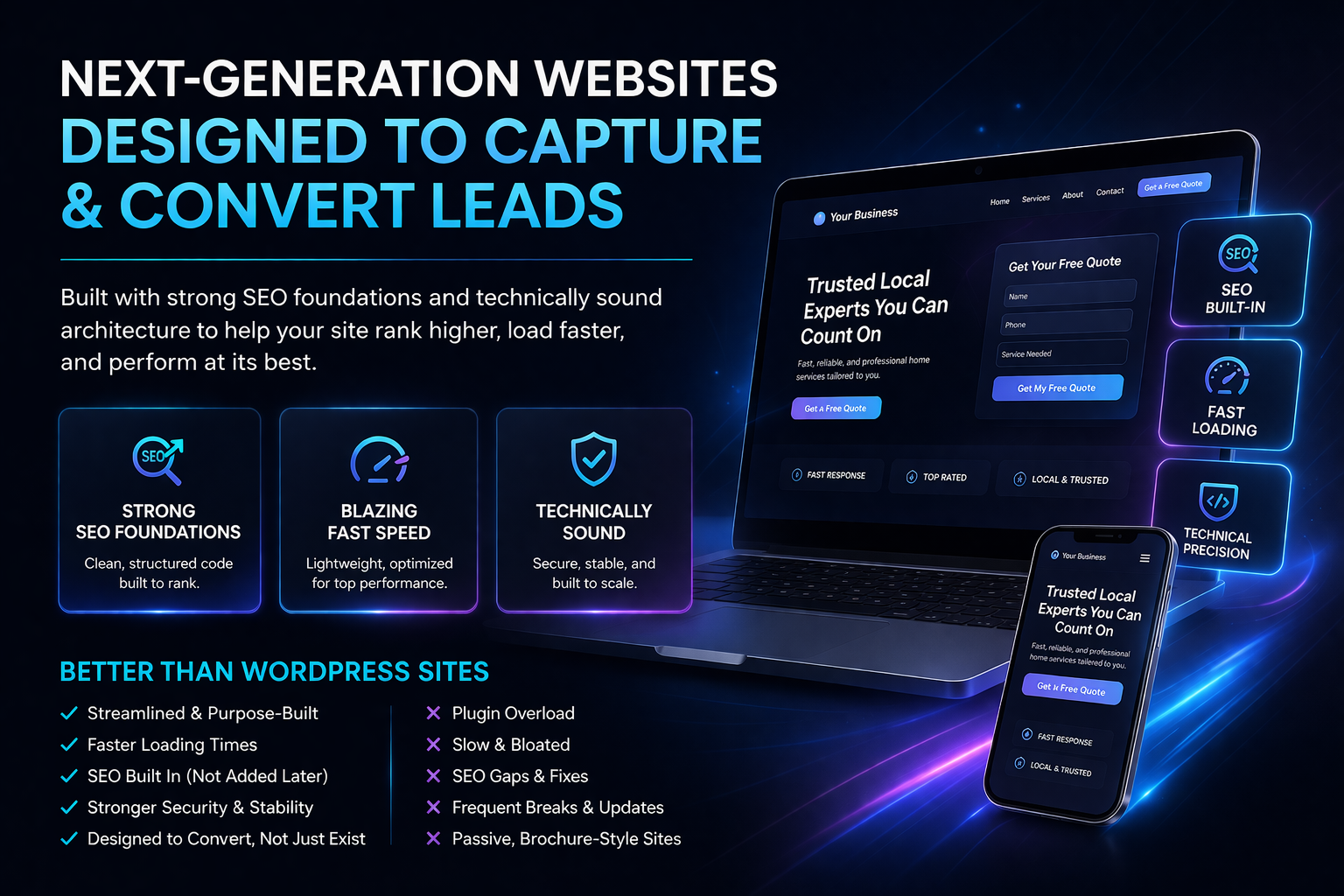
2.Build your [website foundation](/services/next-generation-websites) correctly. — A next generation website structured for SEO, AEO, and GEO from the ground up.
3.Implement a CRM immediately. — Before you scale any channel, you need a system to capture and follow up on every lead.
4.Add review generation as a formal process. — Train your team, create the system, make it automatic.
5.Launch Google Ads for immediate lead flow. — Once your website and CRM are in place, LSAs give you the fastest route to inbound calls.
6.Build content and organic SEO month over month. — Every blog post, every service area page is a long-term asset.
7.Systematize referrals and partnerships. — Build your referral program and invest in trade relationships.
8.Layer in social media, email, and community presence — as your operation grows.
Q: What's the single most important thing separating roofing companies that always have leads from those that are always chasing them?
Consistency.
Not a bigger budget. Not a better market. Not more door knockers or a fancier website. Consistency.
The contractors with full pipelines are doing the right things every single week — collecting reviews, posting content, following up on leads within minutes, nurturing past customers, building relationships, optimizing their digital presence — even when it feels like nothing is happening and results aren't immediately visible.
The gap between a roofing company that's always busy and one that's always worried is almost never about talent, location, or luck. It's almost always about whether they've made a long-term commitment to building a lead generation system — and whether they have the discipline to work it every single week regardless of how full the schedule looks today.
Build the system. Work the system. The leads will follow.
Janette O'Shaughnessy is the founder of Resonating Brands, a digital marketing and web design agency specializing in next generation websites and lead generation systems for roofing contractors and home service businesses. She helps roofing companies move beyond outdated websites and into next generation digital infrastructure built for the way homeowners search today.